




A GitHub commit counts portfolio audit starts with one question: what does your number establish? A busy history describes recorded activity. A useful portfolio also lets someone inspect what you built, how you checked it and which parts you contributed.
We tested that distinction with two original local Git histories. One contains one commit; the other contains five. Both end with exactly the same three tracked files and pass the same two simple assertions. The commit total changes while the final content stays identical.
What Octoverse 2026 actually counts
GitHub’s 28 October Octoverse report and methodology covers 1 October 2025 through 30 September 2026. It reports 17.9 billion pushes and 34.3 billion commits. Unless stated otherwise, its scope includes public and private repositories.
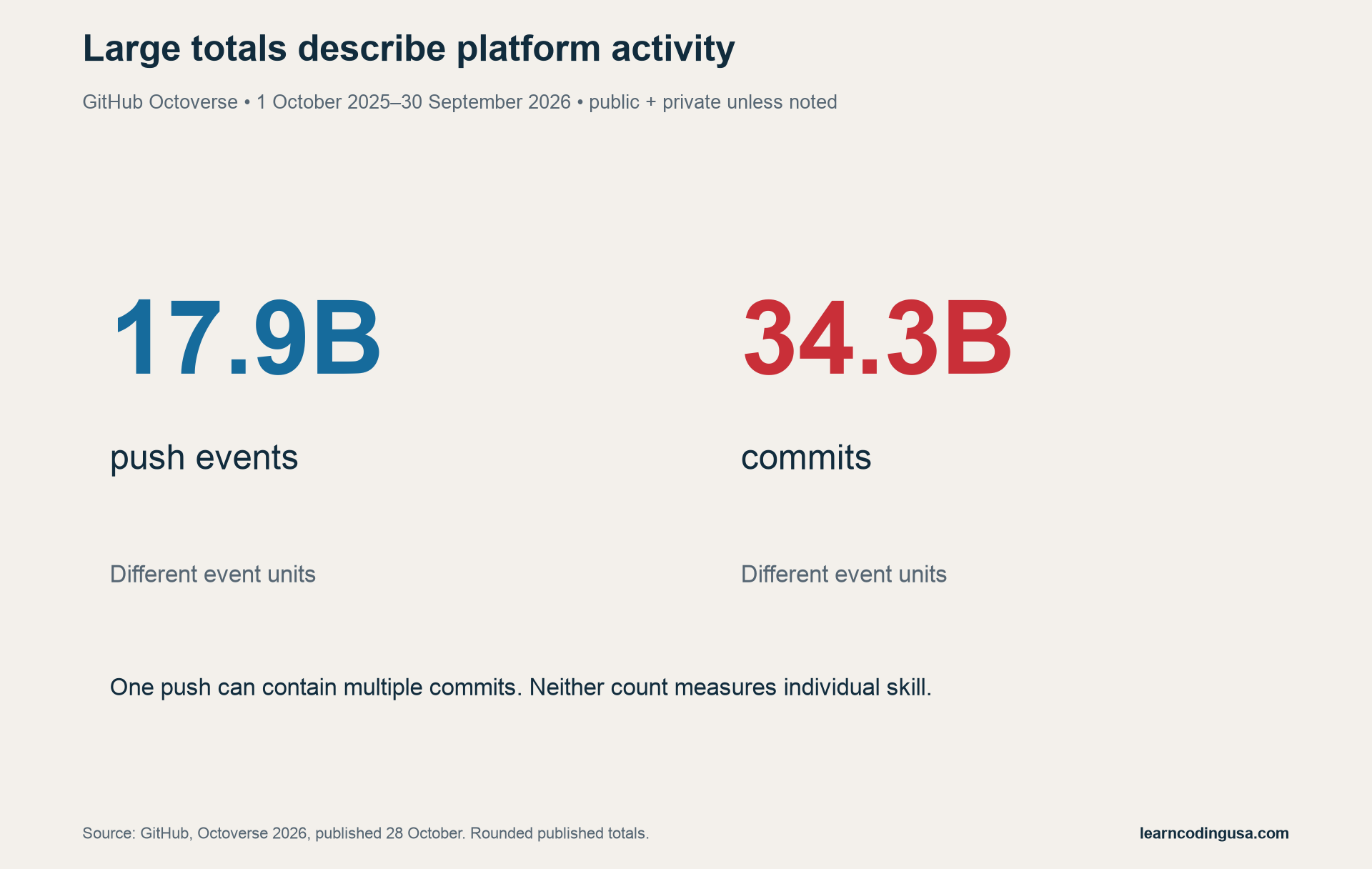
A push can carry several commits. GitHub also recalculated earlier years using consistent definitions and reporting windows. Therefore, mixing this report’s figures with an older report’s differently scoped totals can mislead. These are platform activity measures, not a survey of US vacancies or hiring decisions.
Read the eight-times comparison carefully
Among new repositories, GitHub reports eight times as many average commits when an agent configuration file is present. This is an observed association. The groups can differ in project scale, workflow and other ways. File presence alone cannot establish how much assistance anyone used.
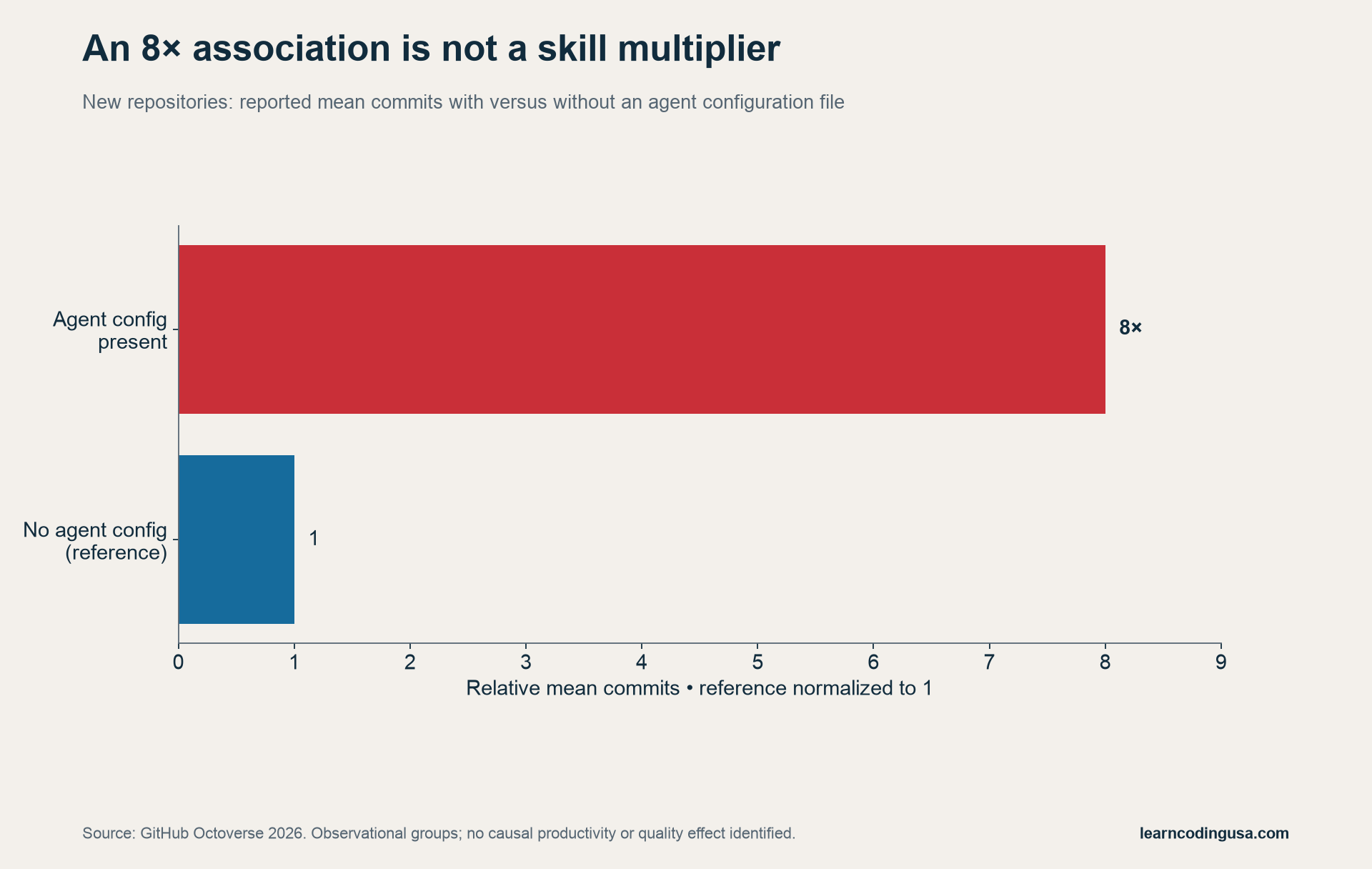
Consequently, do not turn that ratio into a personal productivity multiplier. It does not measure code quality, independent understanding or the value of a finished feature. A US learner can use the report as a prompt to improve documentation without treating it as a personal benchmark.
Our GitHub commit counts portfolio demonstration
We created two isolated repositories on 1 November 2026. Both contain a tiny Python total function, two assertions and a short README. In history A, one commit adds everything. In history B, five commits add the function, checks and documentation in smaller steps.
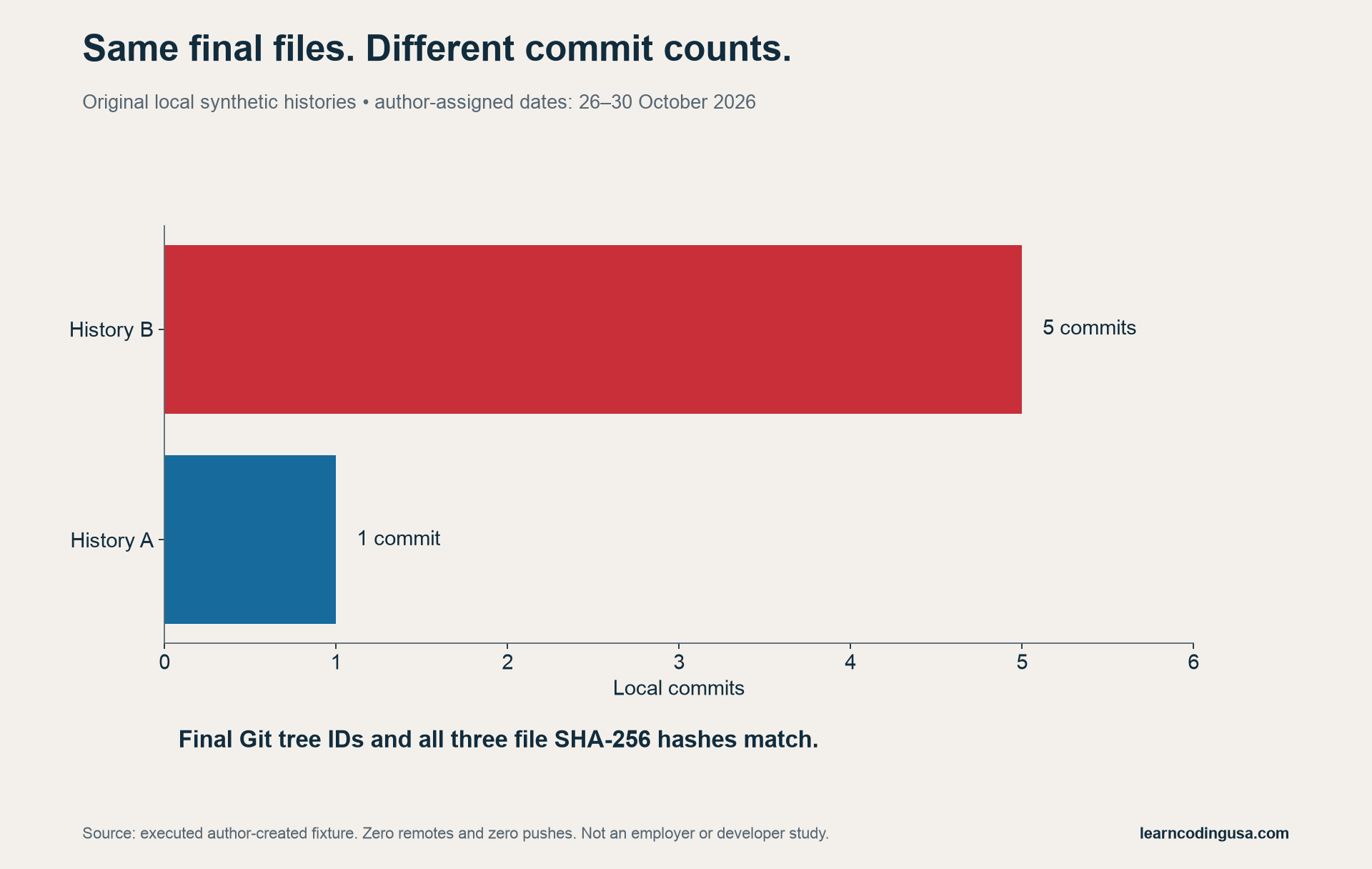
The final Git tree identifier matches across both histories. We also calculated SHA-256 separately for each of the three files; every pair matches. Running the final test script in each repository passed its positive-input and empty-input assertions.
| Local observation | History A | History B |
|---|---|---|
| Commits | 1 | 5 |
| Final tracked files | 3 | 3 |
| Passing final assertions | 2 of 2 | 2 of 2 |
| Configured remotes / pushes | 0 / 0 | 0 / 0 |
| Final content | Identical tree identifier and matching file hashes | |
We assigned synthetic commit dates from 26–30 October to create a shared teaching window. They are not records of real daily development. The experiment used local Git and Python on arm64; no public activity was generated. The downloadable script preserves the fixture and comparison commands.
This deliberately small example does not show that small commits are bad. Granular changes can help review and debugging. It shows why counting history entries cannot establish differences in the final artifact by itself. The two assertions also cover only two behaviors, not overall correctness.

Define your metric before presenting a total
First, declare the repository, dates, branch and source. For example, a count from one local revision range differs from a hosting service’s contribution graph. State how you treat merge commits, generated files and shared work. Keep the definition beside the result.
Next, keep pushes, commits, pull requests, releases and completed requirements separate. A review proposal can contain many changes. A release can package several features. A requirement needs a defined acceptance check. None of those units can simply be added into a universal skill score.
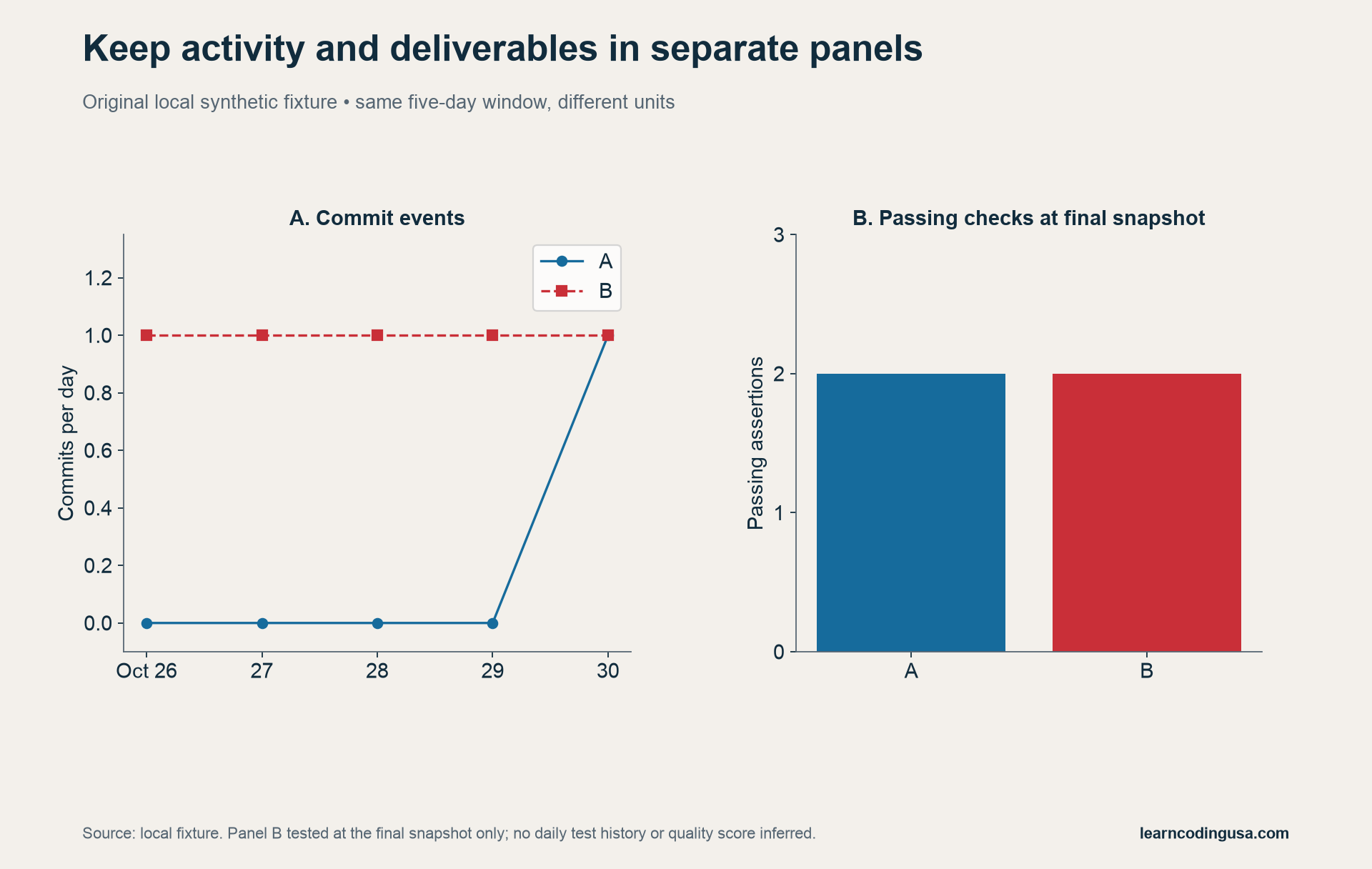
Our paired view uses the same five-day window but different panels. The first displays synthetic commit events. The second displays the checks executed at the final snapshot. We did not run a daily test series, so the chart does not imply that one exists.
Attach evidence to the claim you make
Write one bounded claim per ledger row. Then attach the evidence that allows someone to inspect it. “I added empty-input handling” needs a scoped change and a reproducible check. “We released a tool” needs a release reference and an honest description of your own contribution.
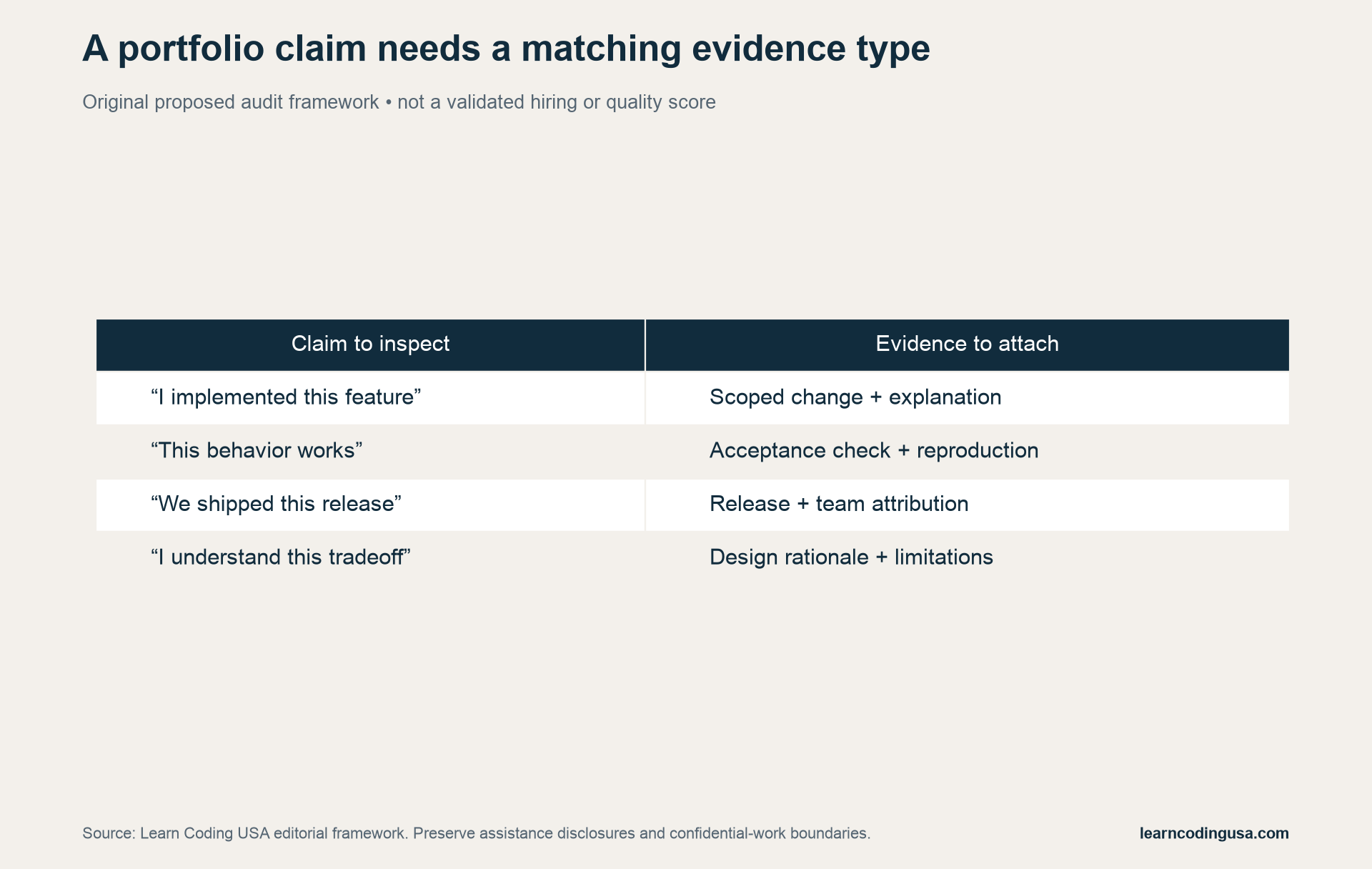
Include a design explanation where it helps. What constraint shaped your choice? Which alternative did you reject, and why? Where does the implementation stop working? A short answer tied to actual code gives readers more to inspect than an unsupported claim of mastery.
Tech Consulting Tailored to Your Coding Journey
Get expert guidance in coding with a personalized consultation. Receive unique, actionable insights delivered in 1-3 business days.
Get StartedDisclose assistance accurately, including templates, tutorials, collaborators and coding tools. For team projects, separate the shared outcome from your attributable work. Avoid exposing private employer code or restricted data. Where public proof is unavailable, describe that boundary rather than treating a sparse public history as failure.
Download the audit tools and reproduce the fixture
Use the blank evidence ledger (CSV) and metric dictionary (CSV) for your own review. Our local history results (CSV), synthetic commit events (CSV) and source values (CSV) keep observations separate from the proposed framework.
Download the reproducible local experiment (ZIP), extract it, inspect experiment.py and place it inside a new empty folder with data and output subfolders. Run python3 experiment.py with Git available. It creates two local repositories, runs their checks and writes the comparison. It refuses to overwrite existing fixture folders and never pushes.
For a more substantial checking exercise, our Sudoku uniqueness project separates an answer from evidence about alternatives. Our Node.js support calendar adds a maintenance boundary that a contribution count cannot show.
Limits of this portfolio audit
We did not test employers, hiring outcomes or developer performance. Our original framework is a communication aid, not a validated selection tool. The tiny synthetic project cannot represent production complexity. Its value is the reproducible counterexample: different commit totals can accompany identical final files.
Before publishing your next project total, check its unit, window and scope. Then add a release, demonstration or check that supports the exact claim. Keep uncertainty visible and let readers inspect the work behind the number.


