




Dependabot dismissal requests now remain open longer, but a longer expiry does not set your team’s review deadline. The useful question is who will review each request, what evidence they need and how long it has already waited.
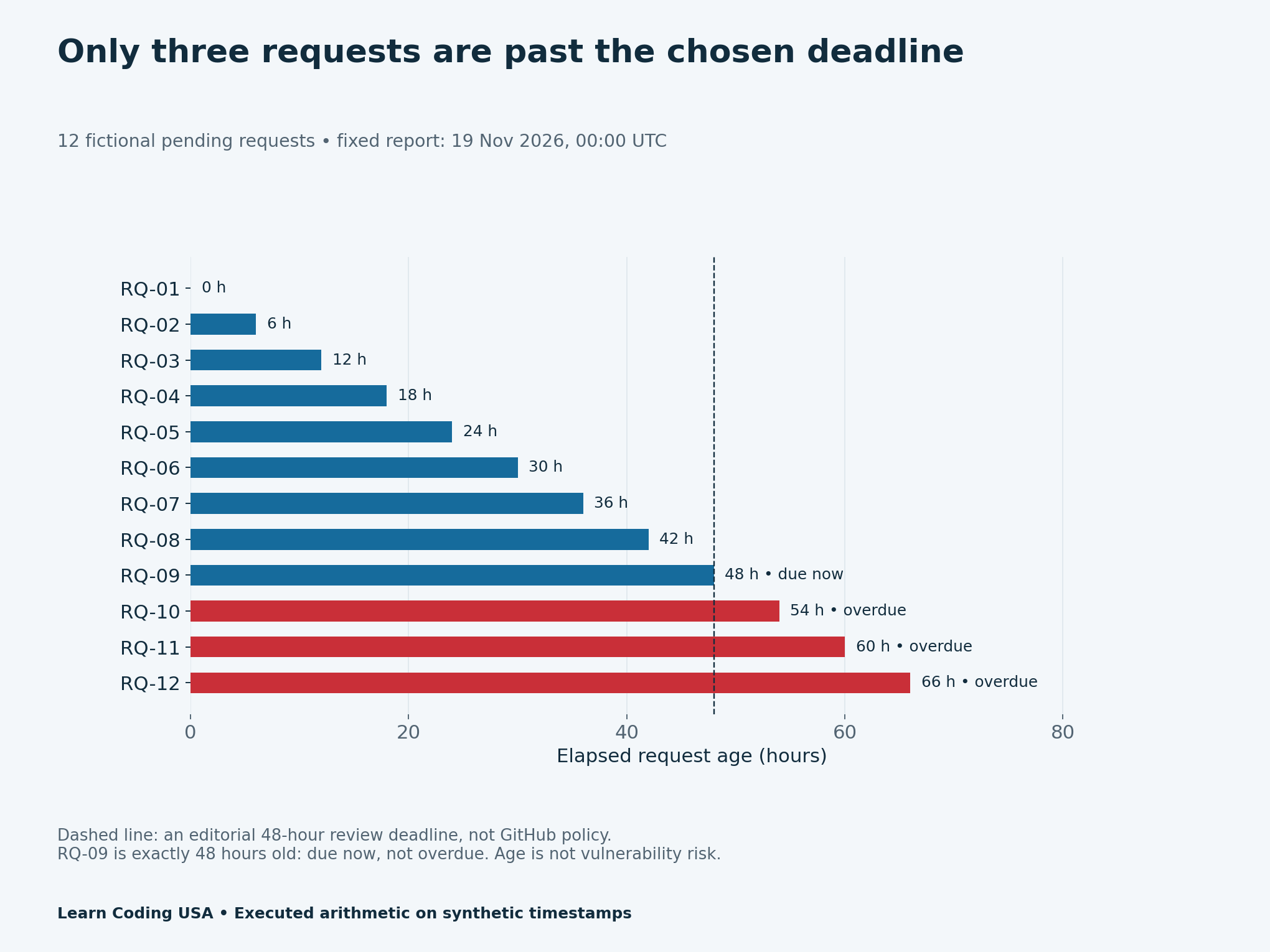
GitHub changed delegated request expiry from one week to one year on 16 November 2026. To make the distinction practical, we calculated a fictional twelve-request queue at a fixed reporting time. Three requests are past our example 48-hour internal deadline. These are worked calculations, not measurements of real repositories or security risk.
What changed for Dependabot dismissal requests?
The GitHub announcement says the longer lifetime is available on GitHub.com and is planned for GitHub Enterprise Server 3.24. That is a product-specific change. It does not mean every Enterprise Server installation already has the behaviour, or that reviewers should wait a year.
Expiry answers when a request stops being available for review and must be submitted again. An internal due date answers when your team intends to review it. Request age answers how much time has elapsed. Keep those three concepts separate rather than using the platform expiry as a work schedule.
Read the fictional queue correctly
Our reporting instant is 19 November 2026 at 00:00 UTC. We created twelve fictional pending requests at six-hour intervals, giving ages from zero to 66 hours. Every request begins on or after 16 November. None is copied from a customer or a live GitHub organization.
We chose a 48-hour review allowance for this exercise. It is an editorial input, not a GitHub requirement or a recommended service target for every project. A real team must consider severity, exposure, reviewer availability and its own policies before choosing a target.
Use elapsed time and a clear boundary rule
For each row, age equals reporting time minus request time. Due time equals request time plus the chosen allowance. We label a request overdue only when the reporting instant is strictly later than its due time. The downloadable runner calculates these values from timezone-aware timestamps.
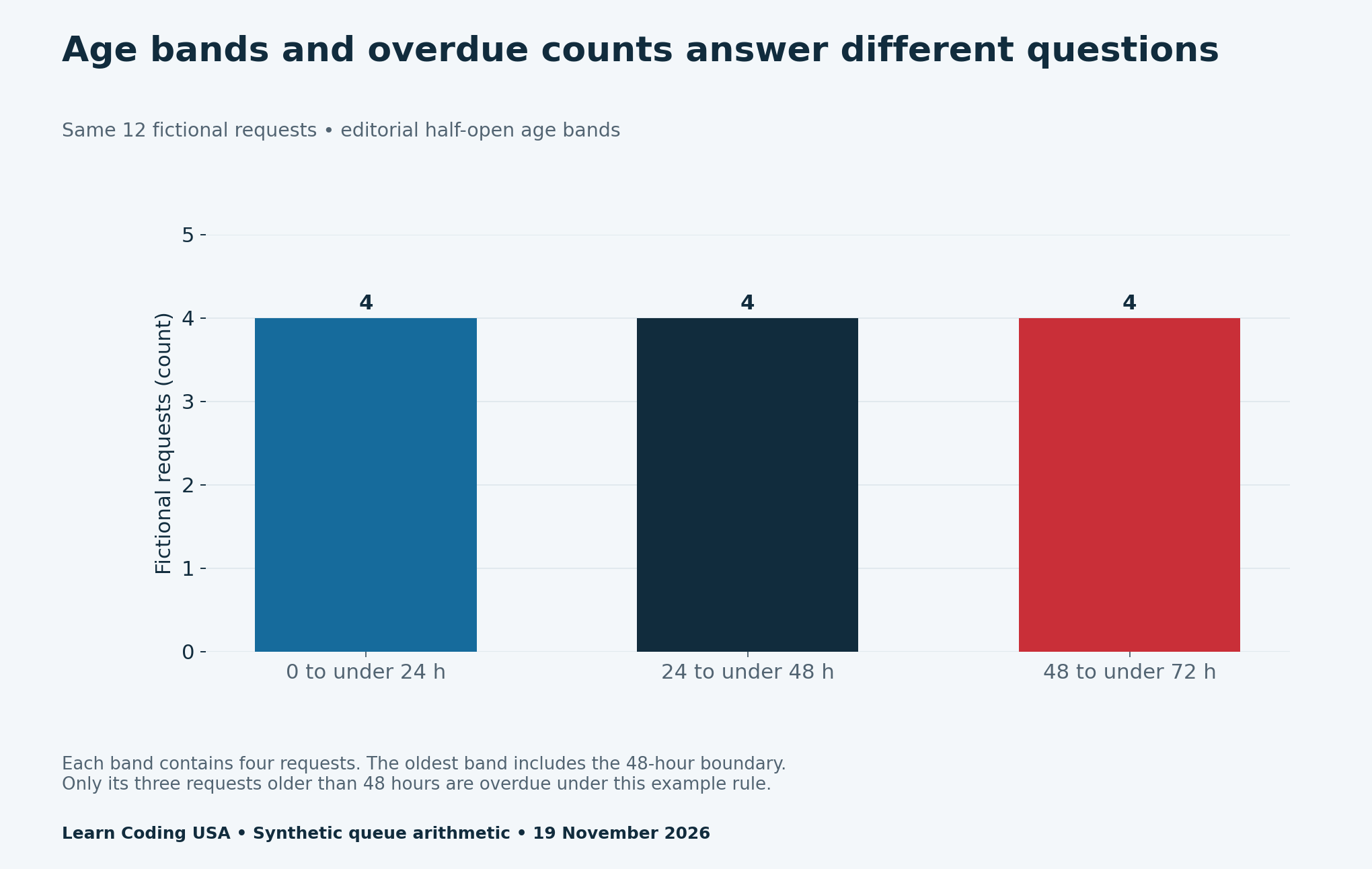
The boundary matters. RQ-09 is exactly 48 hours old. It belongs in the oldest age band, yet it has not passed the deadline under our strict rule. Counting every row in that band as overdue would incorrectly report four instead of three.
| Worked measure | Value | Interpretation |
|---|---|---|
| Pending requests | 12 | Designed teaching rows, not a repository sample |
| Median request age | 33 hours | Middle two ages are 30 and 36 hours |
| Past internal deadline | 3 | Strictly older than 48 hours |
| Exactly at deadline | 1 | RQ-09 is due now |
| No reviewer recorded | 3 | Missing assignment field, not proof nobody is reviewing |
Pending, approved and fixed are different records
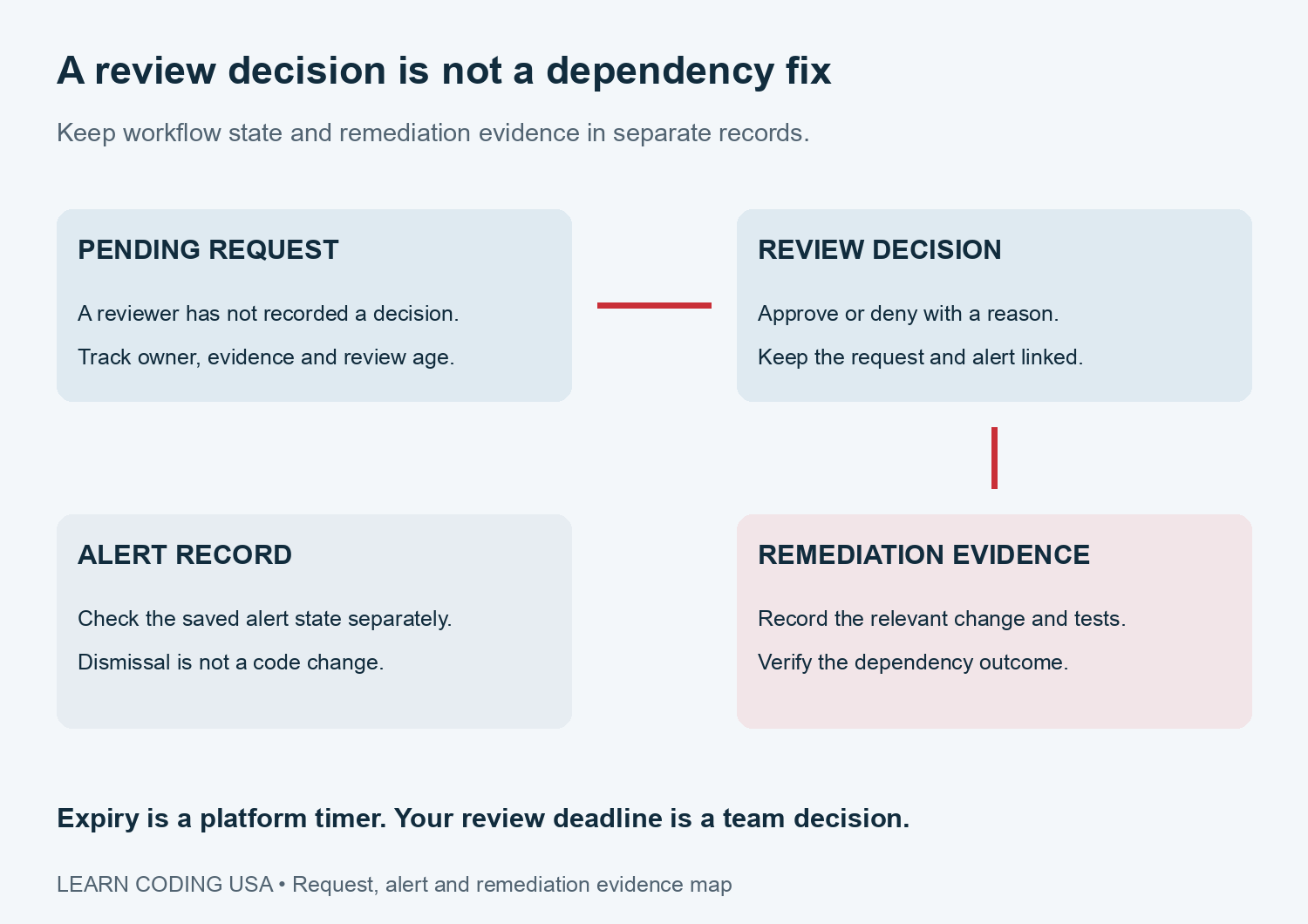
A pending request is waiting for a review decision. Do not describe it as an approved dismissal. Likewise, a recorded dismissal decision does not itself change dependency code or establish that a vulnerable version has been removed. Track the request, alert and remediation evidence separately.
GitHub’s review instructions direct the reviewer to inspect the alert and the requester’s reasoning before approving or denying. Our worksheet records those reasons and a separate next check. It does not decide the outcome based on age, owner name or an empty evidence field.
Assign an owner and make evidence inspectable
First, give each request an accountable reviewer or review role. Our fictional inputs leave three assignment fields blank so the worksheet can flag incomplete records. That shows missing documentation only. It does not establish that a real team has abandoned the request.
Next, capture the alert identifier, requested reason, evidence reference and a review target. An evidence link should help the reviewer examine the claim; its presence alone is not proof that the claim is sound. If a record is incomplete, ask for the missing information rather than treating it as an automatic approval or denial.
For a US coding class or small project, a short scheduled review can make ownership visible. However, urgent security work may require action well before the normal meeting. This teaching queue does not replace an organization’s incident process or a qualified assessment of an actual vulnerability.
Choose review targets without creating false certainty
GitHub’s delegated-dismissal guidance highlights the need for adequate reviewer coverage. Longer request lifetime reduces the need to resubmit an expired request. It does not supply extra reviewers or validate the requested dismissal reason.
Start with a target your team can explain and monitor. State whether you use elapsed hours or business time, which timezone controls the report and what happens when the assigned reviewer is absent. Then inspect overdue work by its actual context. Do not sort solely by age and call the oldest row the highest security risk.
Tech Consulting Tailored to Your Coding Journey
Get expert guidance in coding with a personalized consultation. Receive unique, actionable insights delivered in 1-3 business days.
Get StartedDownload the inputs, calculations and decision tools
- Twelve fictional request inputs (CSV)
- Calculated ages, deadlines and status flags (CSV)
- Blank review decision and follow-up worksheet (CSV)
- Field definitions and interpretation limits (CSV)
- Local calculation script, fictional inputs and instructions (ZIP)
Reproduce the calculation and understand its limits
Run the included Python script in a local folder after reading it. It uses the standard library, needs no GitHub credentials and makes no network requests. Its checks confirm twelve input rows, three overdue rows and correct treatment of the 48-hour boundary. It never submits a review or dismisses an alert.
The ages and assignments are deliberately designed. They cannot estimate typical response times, reviewer productivity or repository safety. The median of 33 hours describes these twelve rows only. We did not test how the new expiry rule applies to historical requests, measure API behaviour or compare organizations.
For related maintenance practice, browse our Software Development Best Practices guides and browser test-evidence ledger. In both workflows, a status label becomes useful when its definition and supporting evidence are explicit.


