




GitHub Actions ARM32 retirement makes a useful distinction urgent: the machine that builds your code may differ from the target your code must run on. A green compilation job cannot stand in for a missing runtime test.
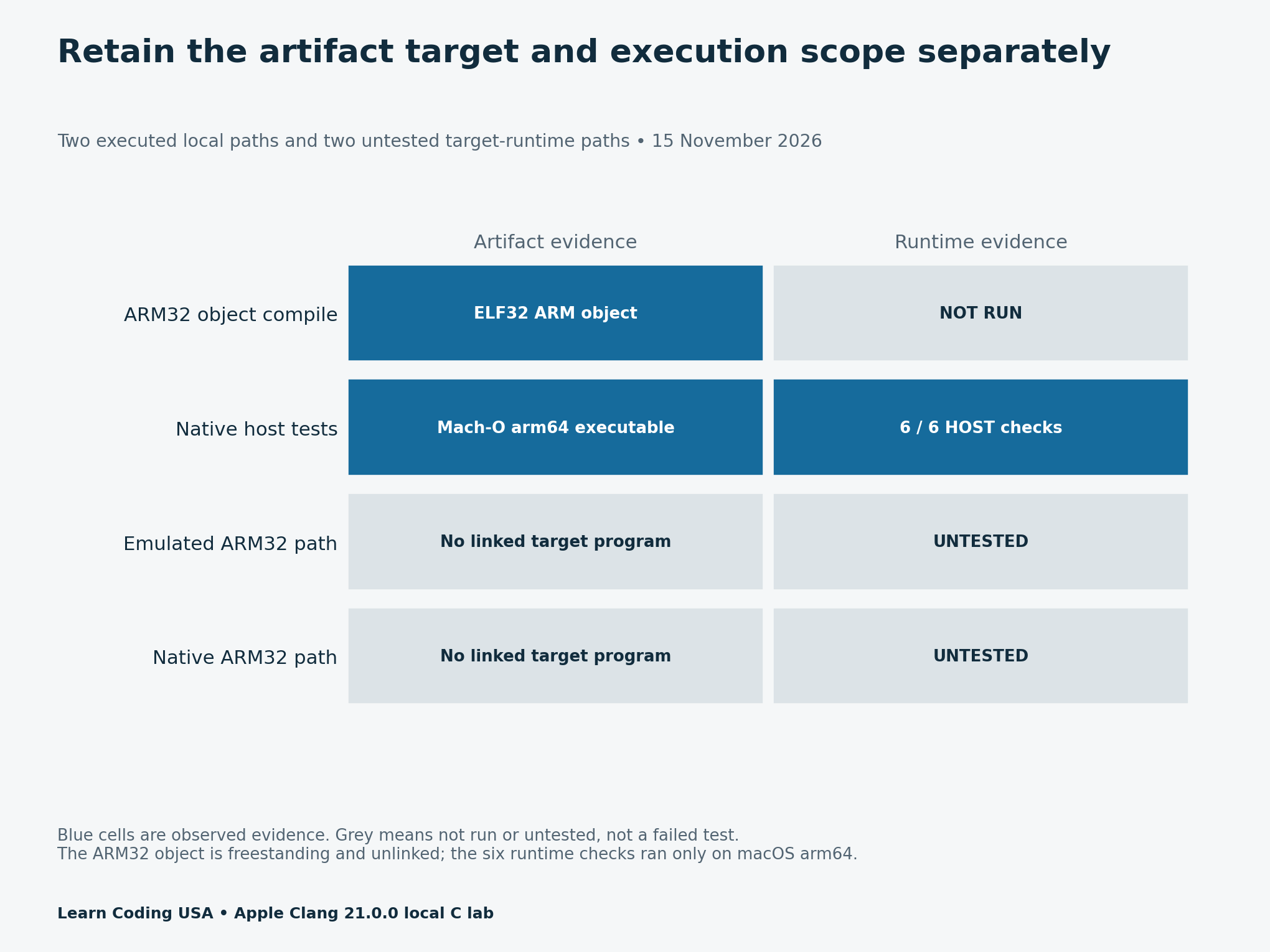
Our small C lab demonstrates that boundary. Apple Clang produced an ARM32 object on an ARM64 Mac. Separately, a native host executable passed all six fixed checksum fixtures. We collected no emulated or native ARM32 runtime result. Those paths remain untested.
What the GitHub Actions ARM32 retirement notice says
GitHub’s 12 November 2026 notice says hosted runners will end ARM32 job execution support on Windows and Linux by 8 December 2026, including native AArch32 user-space execution. It links the change to Node 20’s end of support and states that Node 24 does not support ARM32.
That scope matters. The notice does not say all ARM development stops or that producing every ARM-targeted artifact becomes impossible. ARM32 and ARM64 are different execution architectures. A project needs to identify the affected activity before choosing how to preserve its test evidence.
Four fields to inspect in a pipeline
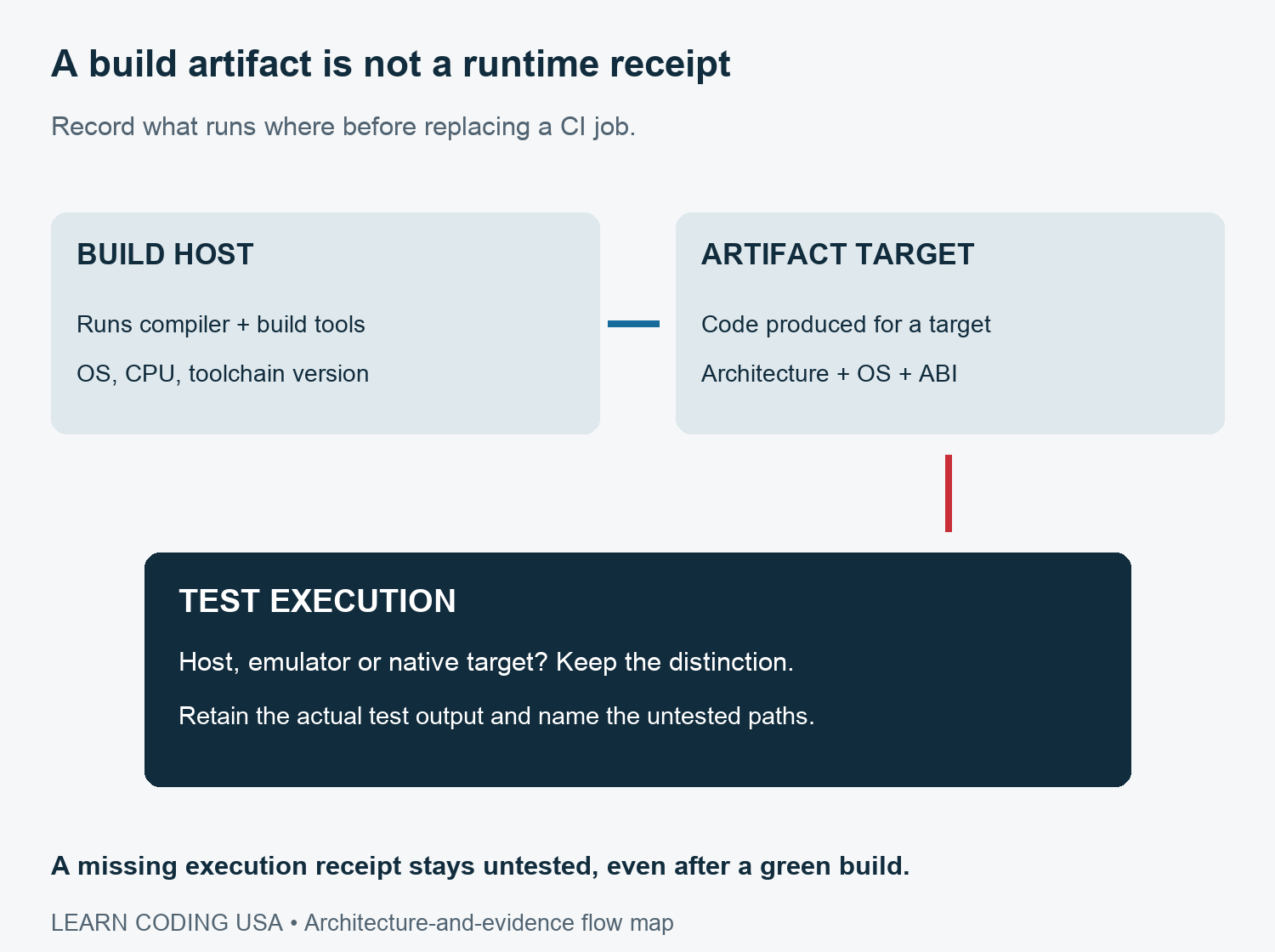
For each relevant job, record the build host, artifact target, execution architecture and evidence retained. Include the operating system and ABI where they affect the result. A target architecture alone does not identify a complete deployment environment.
Next, ask which step actually executes the target program. It may run on the build host, under an emulator or on a separate device. Each answer supports a different claim. A filename ending in “arm” does not prove that the program ran there.
Our locally executed build experiment
We used Apple Clang 21.0.0 on macOS arm64 on 15 November 2026. The example function adds a short sequence of unsigned bytes. Its source needs no platform headers for the freestanding cross-compilation step. The separate host test program prints expected and observed results for six fictional inputs.
First, we built and ran a native macOS executable. Next, we compiled the same checksum function with an explicit armv7-none-eabi target and stopped at the object stage. Both compiler commands exited successfully. We retained their logs and identified the resulting files.
clang -std=c11 -Wall -Wextra -Werror \
  checksum.c host_tests.c -o host-tests
./host-tests
clang -target armv7-none-eabi -std=c11 \
  -ffreestanding -c checksum.c -o checksum-armv7.o
The Clang cross-compilation guide explains the target option and the additional toolchain requirements a real target can involve. Our example deliberately stops before linking. It supplies no ARM operating system, standard library or deployment-ready program.
What the artifact inspection established
The cross-compiled object has an ELF32 little-endian header. Our runner checked the ELF magic, class and byte order, then read the relocatable-object type and ARM machine identifier. The file utility also identified it as an ARM object.
Those checks support the statement that this compiler emitted an ARM32 object for the selected target. They do not show that the object can link with your project’s libraries, boot on a device or behave correctly on hardware. Retaining a target-specific object and retaining target runtime output are separate evidence items.
What the six host fixtures established
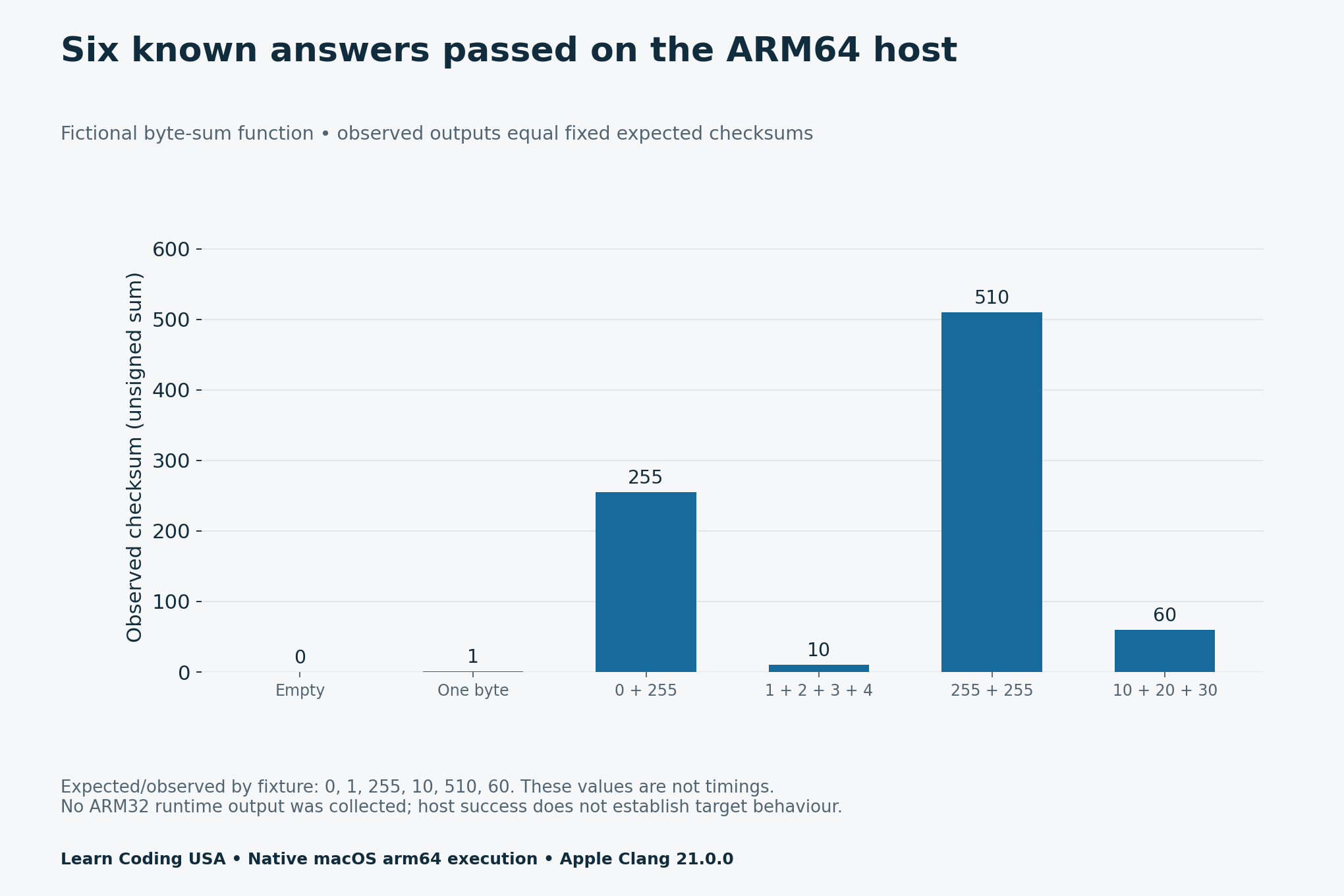
The host executable returned the expected sums for an empty input and five short byte sequences. The fixed expected values were 0, 1, 255, 10, 510 and 60. All six observations matched. These are checksum outputs, not performance measurements or device benchmarks.
The input containing two 255-valued bytes helps show that the result is wider than one byte. However, the fixtures do not cover every length, overflow boundary or invalid pointer. More importantly for this article, every observed runtime result came from the ARM64 Mac, not the ARM32 target.
How to evaluate a replacement test path
Start with the assertion your existing job actually supported. Was it only compilation, general logic on the host, emulated target execution or behaviour on a particular native device? Preserve that distinction in the inventory before changing the job.
Then check the current GitHub-hosted runner reference and the applicable toolchain documentation. A listed architecture does not automatically make your dependencies compatible. A proposed emulator or separate test service needs its own support, access and suitability checks.
Tech Consulting Tailored to Your Coding Journey
Get expert guidance in coding with a personalized consultation. Receive unique, actionable insights delivered in 1-3 business days.
Get StartedFinally, compare the retained evidence before and after a change. If the new path compiles but no longer runs a target test, record that loss openly. We do not recommend an unverified self-hosted arrangement or assume that emulation preserves hardware-specific behaviour. This research changed no workflows or accounts.
Download the inventory and runnable learning lab
- Six observed native-host fixture results (CSV)
- Executed compiler and inspection command ledger (CSV)
- Observed and untested architecture paths (CSV)
- Blank CI architecture and evidence register (CSV)
- C source, Python runner, compiler logs and instructions (ZIP)
For related boundaries, see our agent-skill environment-contract lab and C# union-type experiment. Each keeps an observed operation separate from a broader correctness claim.
Methodology and limitations
This is a local, synthetic teaching experiment using one compiler and one host. The runner records the compiler version, commands, exit statuses, artifact identification and six host results. It retains source and logs in the download pack rather than distributing a ready-to-run device binary.
The ARM32 output is an unlinked freestanding object. Emulated target execution, native ARM32 tests, operating-system integration, library compatibility and production CI migration remain untested. The retirement date comes from the dated GitHub notice; confirm current official guidance before making a deployment decision.


