






AI security alert triage cost is the time needed to decide which reports deserve action, including reports that turn out to be wrong or repeated. Counting alerts emitted is not enough. A useful evaluation also retains review minutes, unique actionable findings and known issues that the tool missed.
This guide includes an original triage ledger, a fictional answer key and reproducible cost calculations. No AI scanner, vulnerable-code test or human timing trial was executed. The worked numbers are chosen teaching inputs; the separately cited survey values are publisher-reported evidence.
Why the new report needs careful denominators
An OpenSSF article published 9 November draws attention to the maintenance burden discussed in new Linux Foundation research. That makes a practical question timely: how much reviewer effort does your own security workflow require once alerts arrive? A project-level ledger can answer a different, narrower question than a broad survey headline.
The Linux Foundation report describes 308 qualified respondents surveyed during June–July 2026. It reports security-related work completed 17% faster on average and a 30% workload increase from false-positive reports. These are different self-reported measures, not values to subtract into a 13% net loss. The sample is global, not a representative trial of every US team.
A caption mismatch worth preserving
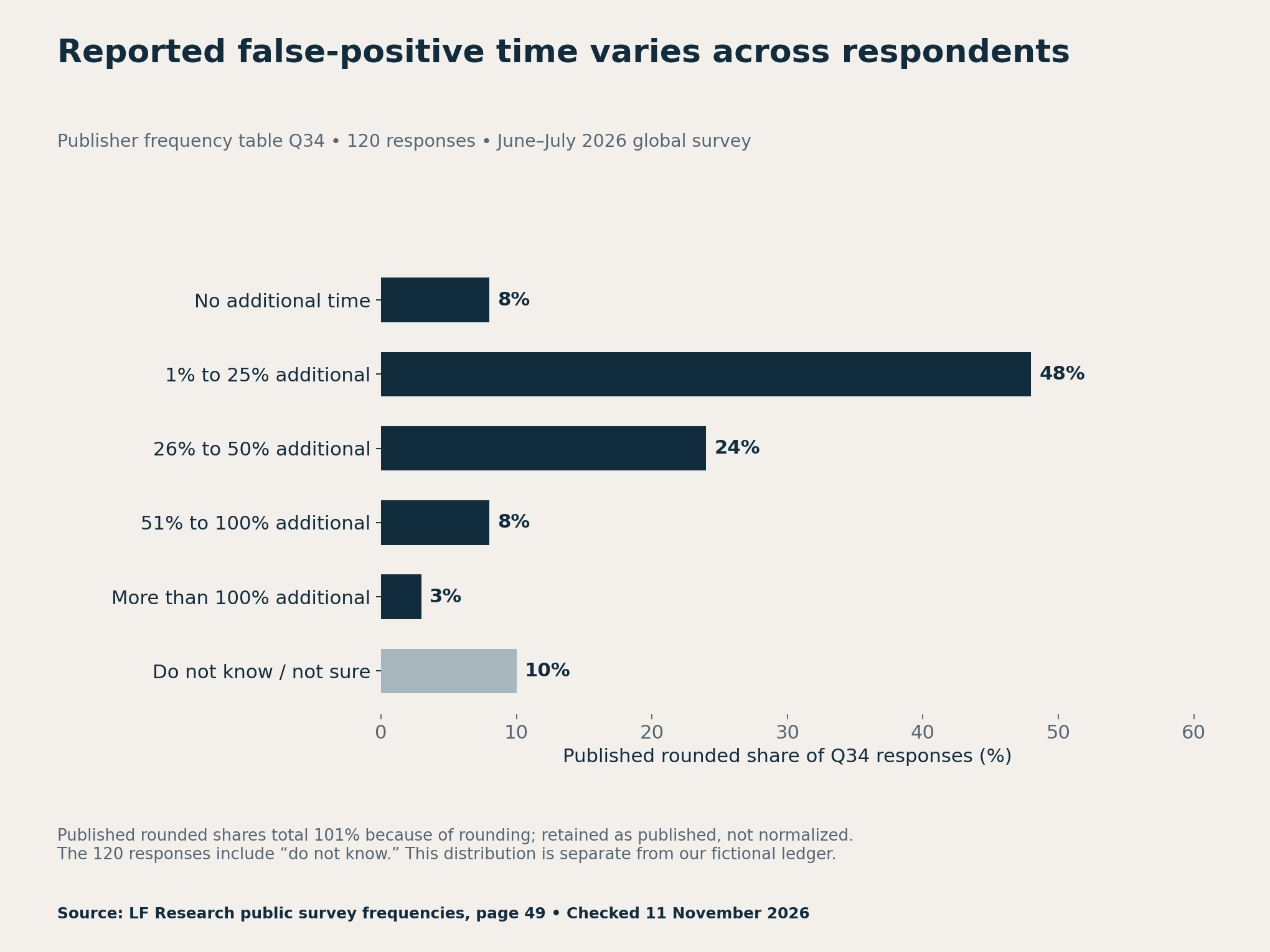
On page 26 of the report PDF, Figure 19’s caption lists Q30, Q11 and Q31. The publisher’s public frequency tables instead identify Q34 as the false-positive-time question and Q35 as the task-time question, with 120 responses each, including “don’t know” answers. We retain that discrepancy rather than assign the full 308 sample to either average.
We have not independently recomputed the reported averages from respondent-level data, and the 120 response count is not a confirmed denominator for each calculated mean. The publisher’s dataset record provides the supporting materials. Our source ledger keeps the report’s statements and the frequency-table observations separate.
Define an actionable finding before reviewing tools
A report can be correct yet irrelevant to the tested configuration, or it can repeat an issue already recorded. Define the acceptance rule for the exercise: what evidence makes a unique finding actionable, which version is in scope and who adjudicates uncertain cases? Keep severity and remediation decisions separate from whether the report is correct.
Use only an owned, deliberately prepared test corpus when evaluating detection. Retain its known-issue key before a scan. A live third-party application is not a test fixture. Our downloadable answer key is fictional teaching material and is not a real vulnerable corpus or evidence that a product detects a particular weakness.
Keep duplicate alerts separate from false positives
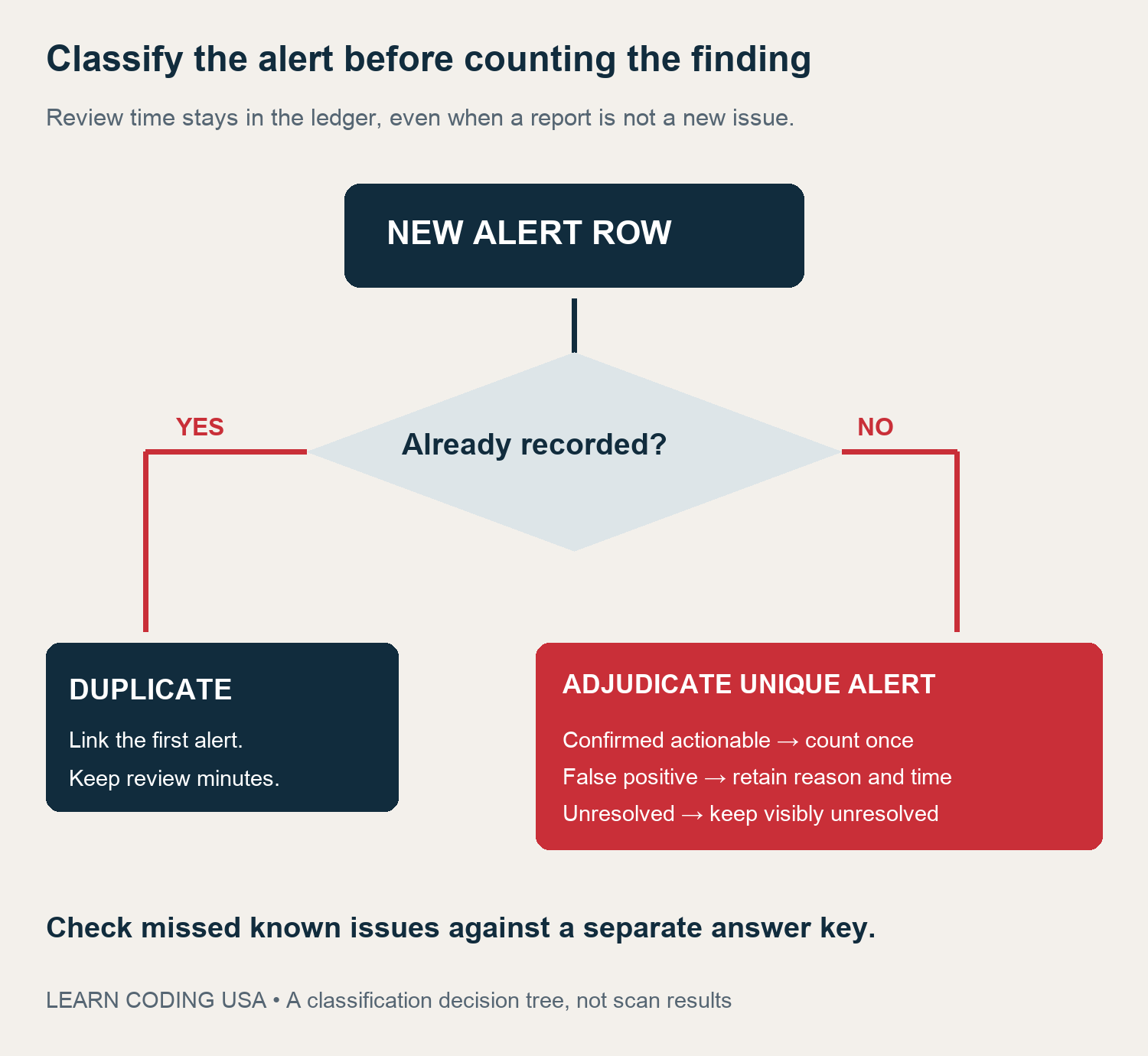
Our fictional ledger has eight alert rows: four unique true findings, three false positives and one duplicate of the first true finding. The duplicate does not create a fifth unique finding. It also is not evidence that the original issue was false. We retain its one minute of chosen review time because handling it still consumes effort.
For unique adjudicated alerts in this example, precision is 4 ÷ (4 + 3) = 57.1%. Counting the duplicated true report as another true alert would instead produce 5 ÷ 8 = 62.5%, a report-row measure. Label the unit explicitly. Neither calculation is an observed scanner-quality estimate.
| Unit | Fictional count | What it represents |
|---|---|---|
| All alert rows | 8 | Includes the repeated report |
| Unique adjudicated alerts | 7 | Four true findings and three false positives |
| Unique actionable findings | 4 | Each confirmed issue counted once |
| Duplicate rows | 1 | Linked to its first alert, with time retained |
| Known issues in answer key | 6 | Four chosen detected and two chosen missed |
Add review time before dividing by useful findings
The four fictional true-finding reviews take 5, 6, 4 and 5 minutes, totalling 20. The false-positive reviews take 2, 3 and 4 minutes, totalling 9. The duplicate adds 1. Total review effort is 30 minutes, so review minutes per unique actionable finding are 30 ÷ 4 = 7.5.
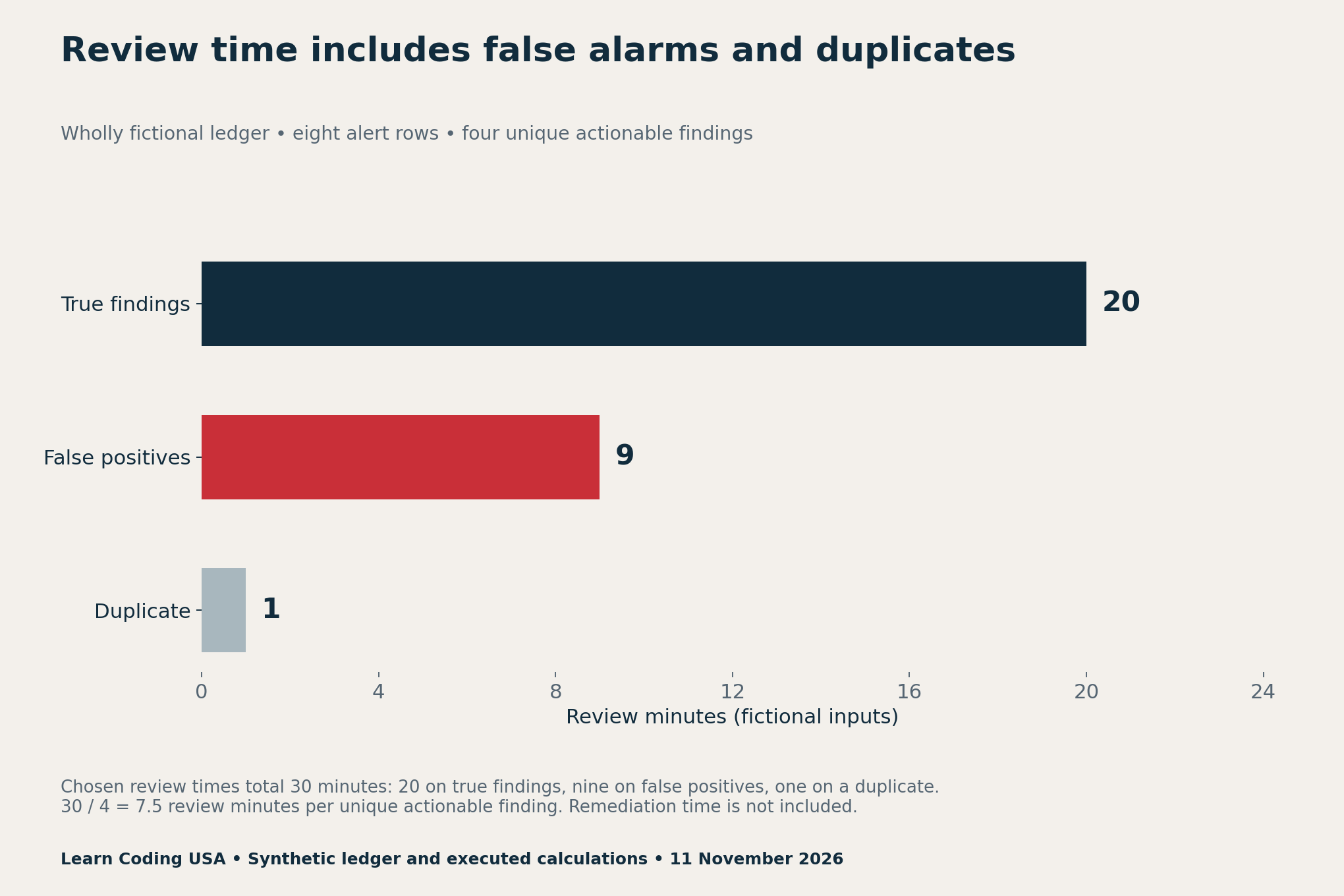
Do not discard the false and duplicate rows before summing the numerator. That would hide work the reviewer actually did. Also avoid double counting: if duplicate handling is already included in another timed session, allocate it once and explain the rule. Keep active effort and elapsed turnaround distinct.
When no actionable finding is confirmed, minutes per actionable finding is undefined. Do not report zero or invent an infinite point on a chart. Report the spent minutes and the zero finding count separately. If verdicts remain unresolved, keep their time and status visible and explain which precision denominator excludes them.
Track missed known issues alongside precision
A tool can produce very few false alarms by reporting very little. Our fictional answer key contains six known issues, while only four have a first alert. The chosen missed count is two and the chosen detection share is 4 ÷ 6 = 66.7%. That is a property of the supplied teaching labels, not a scanner result.
For an actual controlled test, compare each unique alert to the retained key and examine unreported known issues. Confirm the ground truth independently before treating a missed case as a tool failure. In ordinary production software, the complete issue population is usually unknown, so a clean detection denominator may not exist.
Tech Consulting Tailored to Your Coding Journey
Get expert guidance in coding with a personalized consultation. Receive unique, actionable insights delivered in 1-3 business days.
Get StartedUse sensitivity arithmetic before making a savings claim
False-alert review cost equals false-alert count multiplied by minutes per false alert when the cost per alert is held constant. Twenty false alerts at three minutes each consume 60 minutes. That is an illustration of multiplication, not a claim about a typical team or the survey respondents.
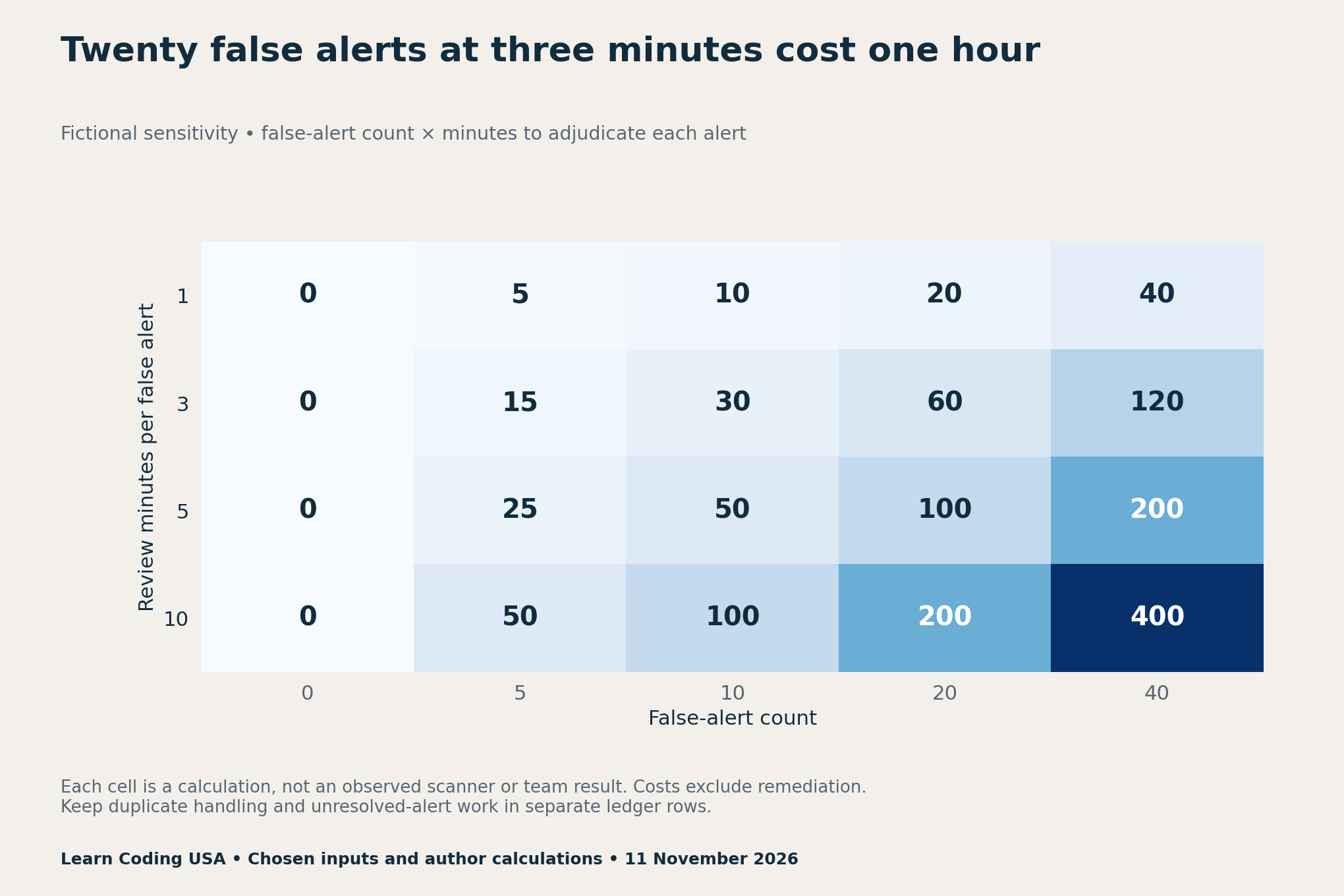
An hourly cost can be added later using a stated currency and documented rate. Do not insert a US salary estimate merely to produce an impressive dollar total. Keep subscription, setup, triage, remediation and verification costs separate, then state precisely which categories your comparison includes.
Design a fair comparison on an owned fixture
Use the same starting revision, known issues, acceptance criteria and time categories for each tool. Pin scanner and model versions, prompts and configuration. Record the reviewer’s familiarity. Alternate task order or use matched variants so the second run is not simply benefiting from remembered answers.
Keep the ground-truth key away from the working prompt until adjudication. Retain raw alerts and verdict changes without publishing credentials, private repository paths or sensitive code. If a report turns out to be a genuine new issue, follow the owner’s disclosure process rather than exposing it in a public benchmark table.
A generated patch is another item to review. Detection correctness does not prove that a proposed fix preserves behaviour or removes the weakness. Log remediation and verification separately. The supplied ledger leaves those fields open because our teaching exercise did not perform either activity.
Download the cost and coverage tools
- Report and frequency-table source ledger (CSV)
- Eight-row fictional triage example (CSV)
- Blank alert and review-time ledger (CSV)
- Fictional known-issue answer key (CSV)
- False-alert cost sensitivity calculations (CSV)
The source file preserves question IDs and the caption caveat. The worked ledger and answer key are wholly fictional. The blank file is for your observations. The sensitivity file contains twenty reproducible multiplications, not a set of benchmark runs.
For a broader effort-comparison design, use our AI browser testing benchmark. For version and distributor evidence across development tools, see the Git security update checklist. These address different controls and do not establish scanner performance.
Method, limitations and citation
Research checked 11 November 2026. We inspected the report’s chart and methodology pages and the public frequency tables, keeping their source labels separate. We executed the original ledger counts, cost totals, precision examples and sensitivity arithmetic. No AI security scanner, exploit test, human timing study or independent survey replication was performed.
Suggested citation: Learn Coding USA, “AI Security Alert Triage Cost: Count the Review Work,” 11 November 2026. Cite Sam Boysel’s Linux Foundation report for its survey findings and this report for the original teaching ledger and calculations. Send evidence-backed corrections through our contact page.


