




The US software developer job market 2026 gained a positive October signal: CompTIA reports 51,944 new software developer and engineer postings, up 6.3% from September. That supports a claim about advertised demand. It does not establish that 51,944 people were hired, that the openings are all distinct or that beginners qualify for them.
For a new coder, the useful question is narrower than whether the market has “recovered.” Which current employer listings match your location, experience and work eligibility? The national release cannot answer that. It can provide context while you collect the role-specific evidence.
Our original calculation puts software developer and engineer postings at 17.86% of all new IT-occupation postings in October. Below, five charts distinguish posting activity, growth and unemployment. A separate evidence-chain infographic and four CSV downloads help you move from a headline to a documented application decision.
What changed in the US software developer job market 2026?
CompTIA’s original release, published on 6 November, describes October observations. It reports 290,892 new IT-occupation postings, with 629,876 active IT postings. New activity rose 4.5% from September and 22.2% from October 2025; active activity rose 18.5% annually.
These are dated source figures, not an independent scrape by Learn Coding USA. CompTIA attributes employer-posting data to Lightcast and employment estimates to the US Bureau of Labor Statistics. Both can be revised. The release also warns that monthly occupational estimates have substantial volatility.
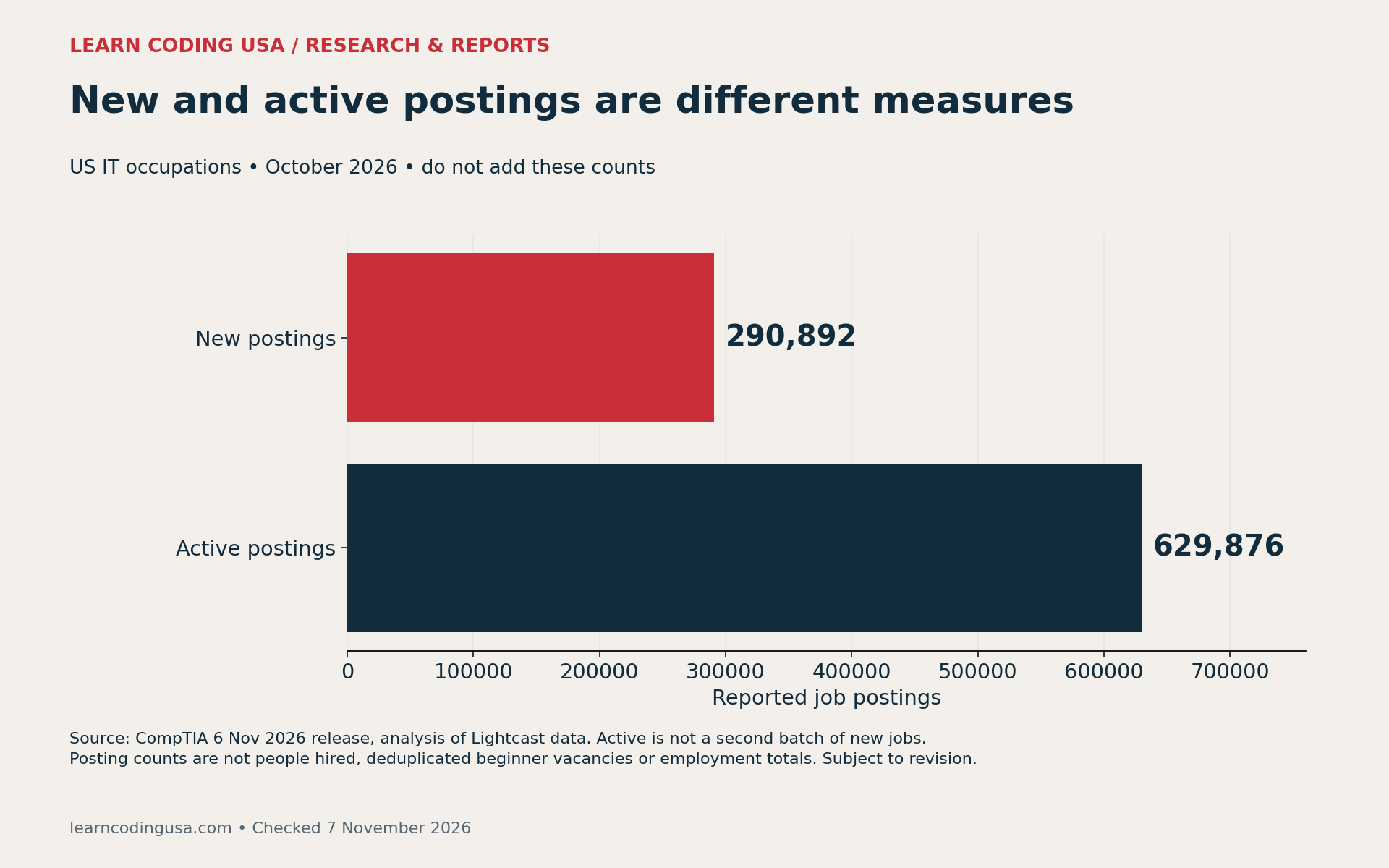
An active posting count is not another batch of new jobs to add to the new-posting figure. Nor does subtracting new from active reveal a clean backlog of unique unfilled positions. The public release does not supply the listing-level records needed to make that interpretation.
Software represents 17.86% of new IT postings
The software occupation count and the new IT-posting count share the same month and posting basis. That makes the following calculation meaningful: 51,944 ÷ 290,892 × 100 = 17.86%, rounded to two decimal places. The corresponding remainder is 238,948 new postings in other IT occupations.
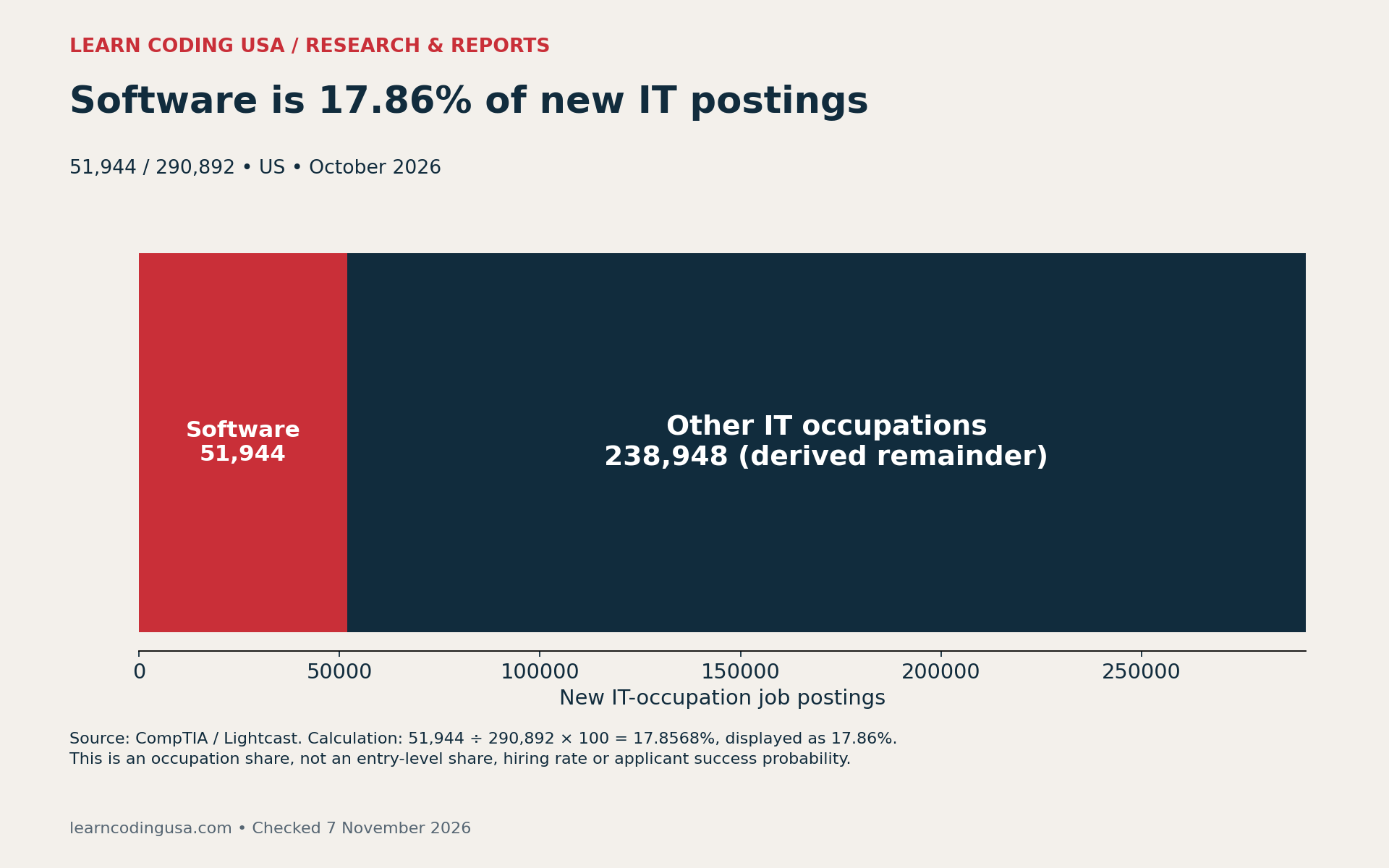
The denominator matters. Dividing the software-new count by active IT postings would mix a newly added subset with a different activity measure. Also, nothing in the 17.86% calculation describes experience requirements. Senior and junior roles cannot be separated from these aggregate figures.
| Measure | October figure | Interpretation limit |
|---|---|---|
| New software developer/engineer postings | 51,944 | Advertisements, not verified hires or a junior-only count |
| New IT-occupation postings | 290,892 | The denominator for the software occupation share |
| Software share of new IT postings | 17.86% | Derived occupational composition, not hiring probability |
| Active IT postings | 629,876 | Different posting measure; do not add to new postings |
A positive month does not settle the recovery question
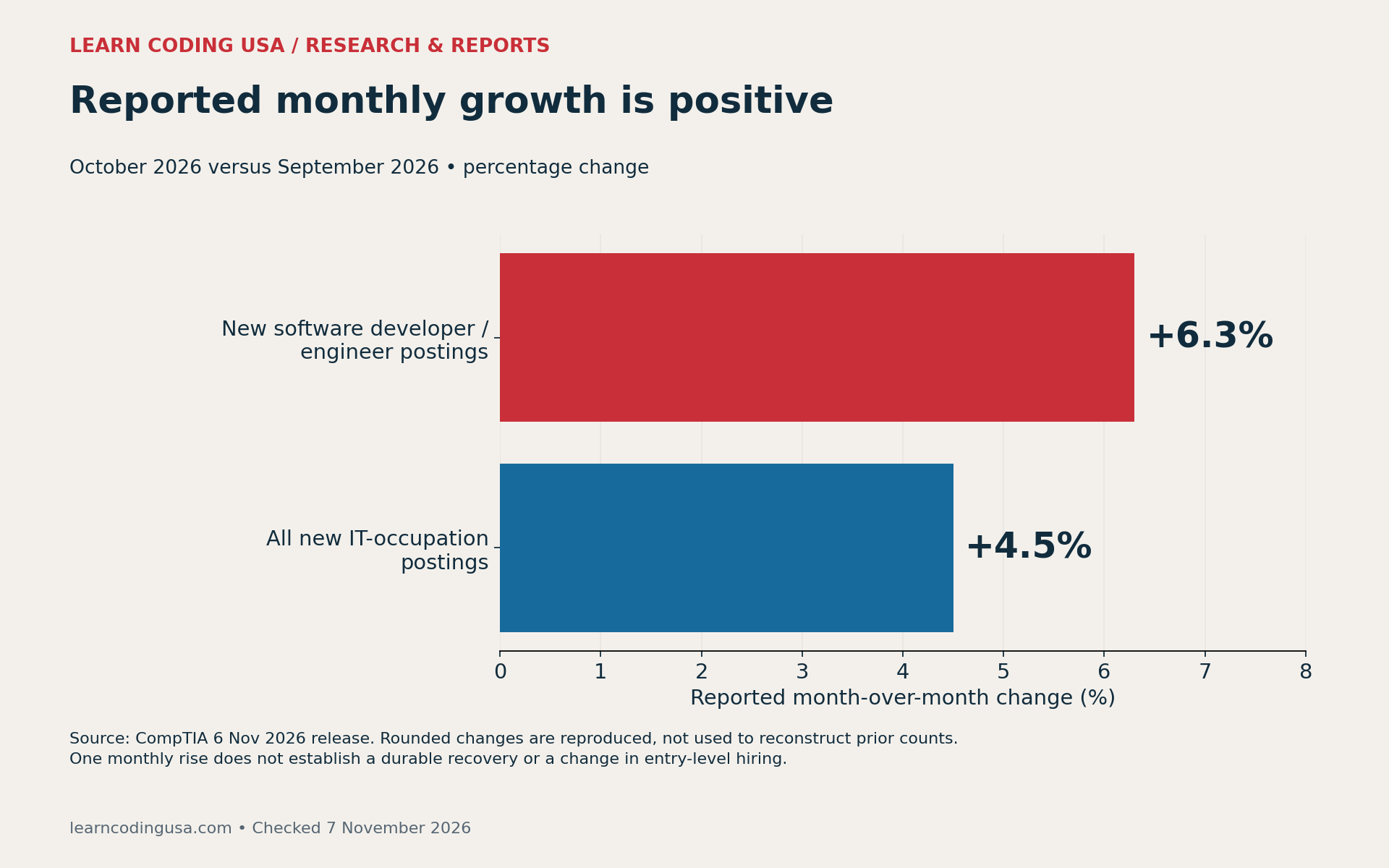
The software-new series rose 6.3% monthly, while all new IT postings rose 4.5%. These reported percentages show a positive comparison with the previous month. They do not establish how long an improvement will last or whether a beginner’s target segment improved.
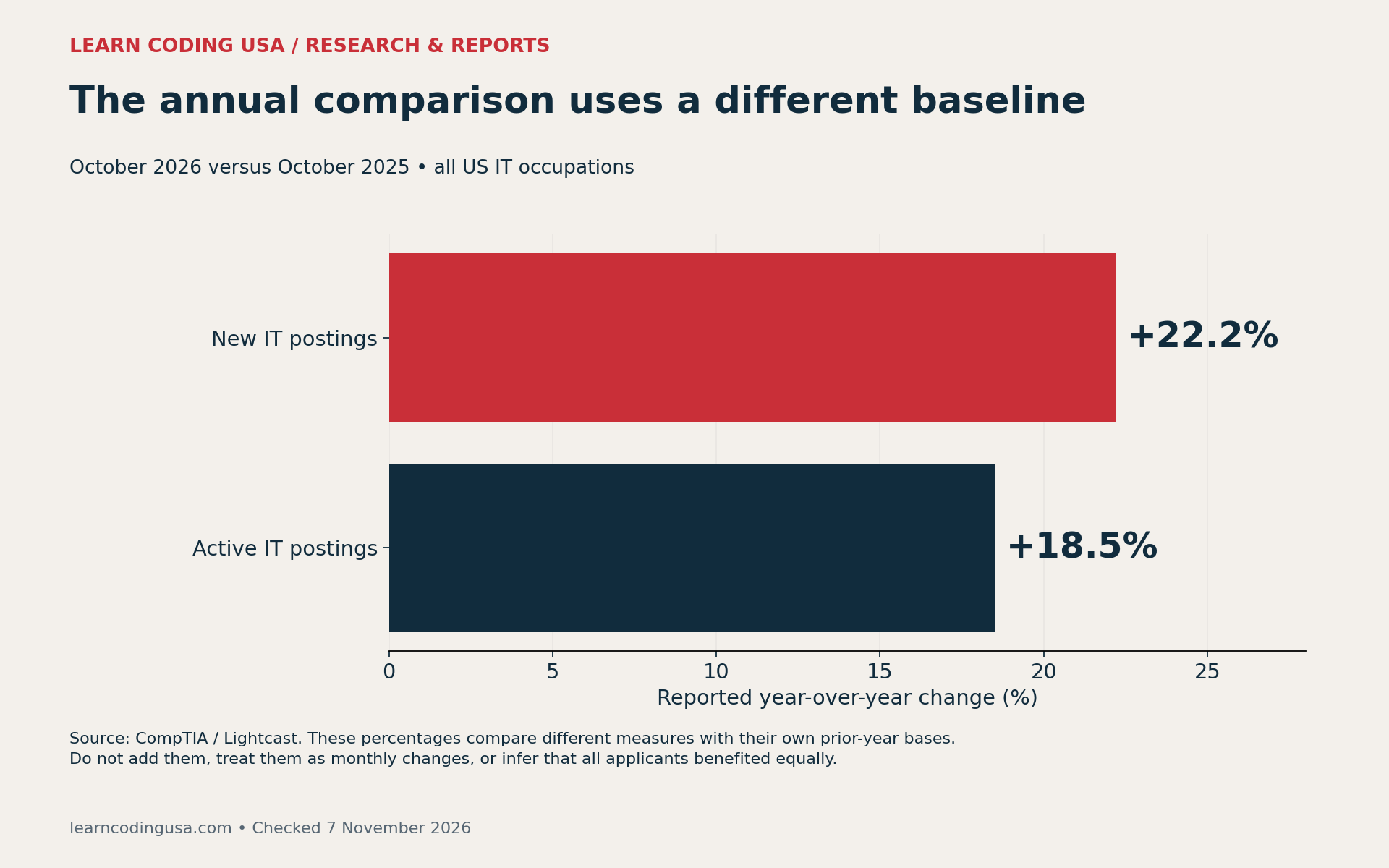
Keep the annual figures separate. The 22.2% rise in new IT postings and 18.5% rise in active IT postings compare October with the same month a year earlier. Those are not additional monthly gains. Adding them would create a number with no clear statistical meaning.
A sound reading of the US software developer job market 2026 therefore keeps several questions open. Are suitable employers advertising junior work? Are those roles still open? What skills recur among listings you can actually pursue? An aggregate national increase cannot fill those gaps.
Industry jobs, occupational employment and unemployment differ
CompTIA also estimates an increase of approximately 7,200 tech-industry jobs and approximately 26,000 IT-occupation jobs across the economy. Do not combine them into a 33,200-job total. A software role may sit in a technology company or in another industry, so the groups overlap.
The BLS comparison of household and payroll surveys explains a second distinction. Payroll estimates count jobs at establishments, whereas household employment estimates concern people. A person with multiple payroll jobs can enter the payroll measure more than once. The surveys also differ in scope and methodology.
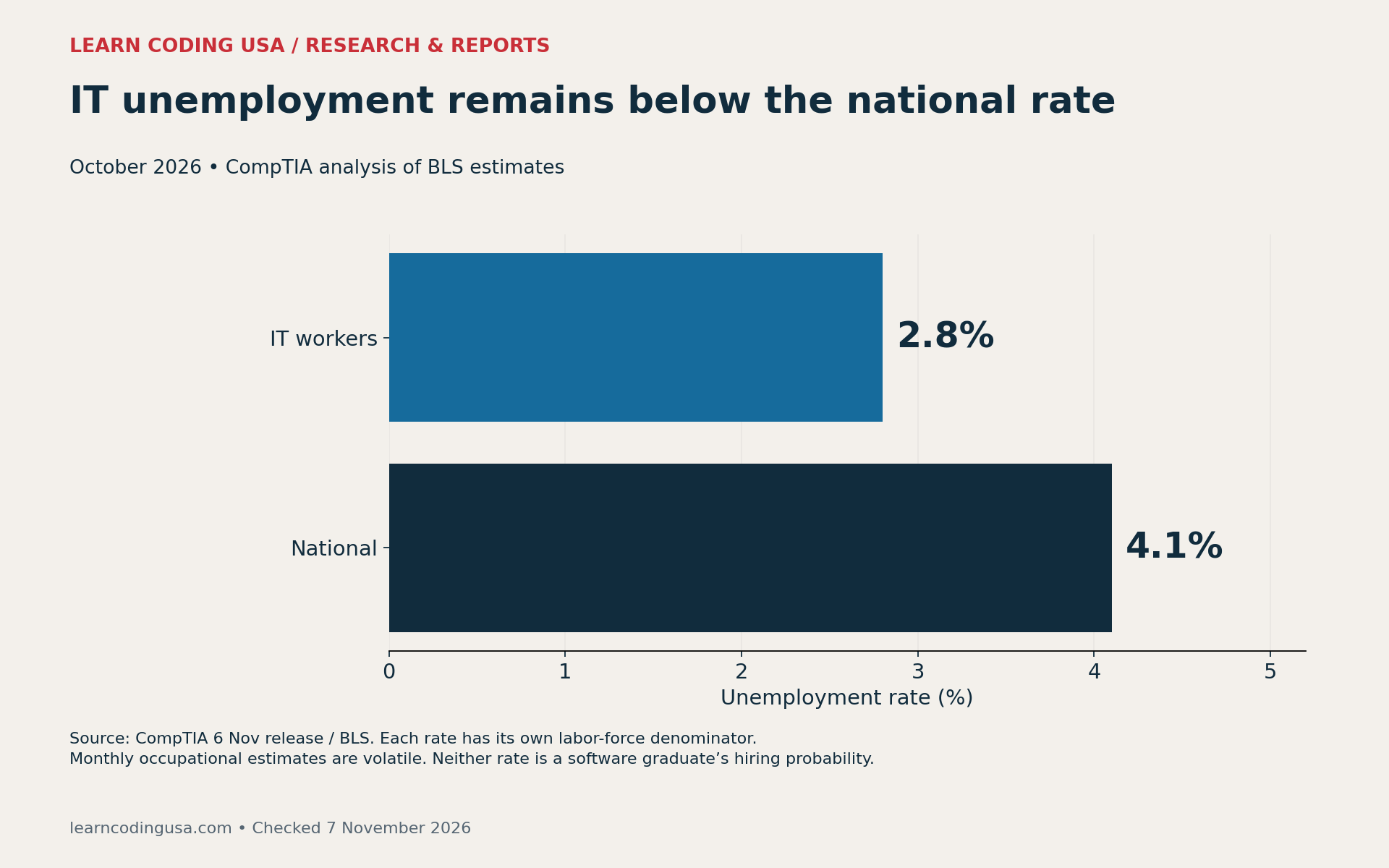
The release places IT unemployment at 2.8%, below 4.1% nationally. That is useful labor-market context. It is not a prediction for a particular learner, a measure of vacancies available to graduates or evidence that every software specialty has the same conditions.
Build an evidence chain from headline to application
Begin with the national signal, then narrow the question to your actual constraints. Choose a role family, locations or remote-work boundaries, and realistic experience requirements. Next, open the employer’s original careers page rather than relying only on a copied listing.
Tech Consulting Tailored to Your Coding Journey
Get expert guidance in coding with a personalized consultation. Receive unique, actionable insights delivered in 1-3 business days.
Get Started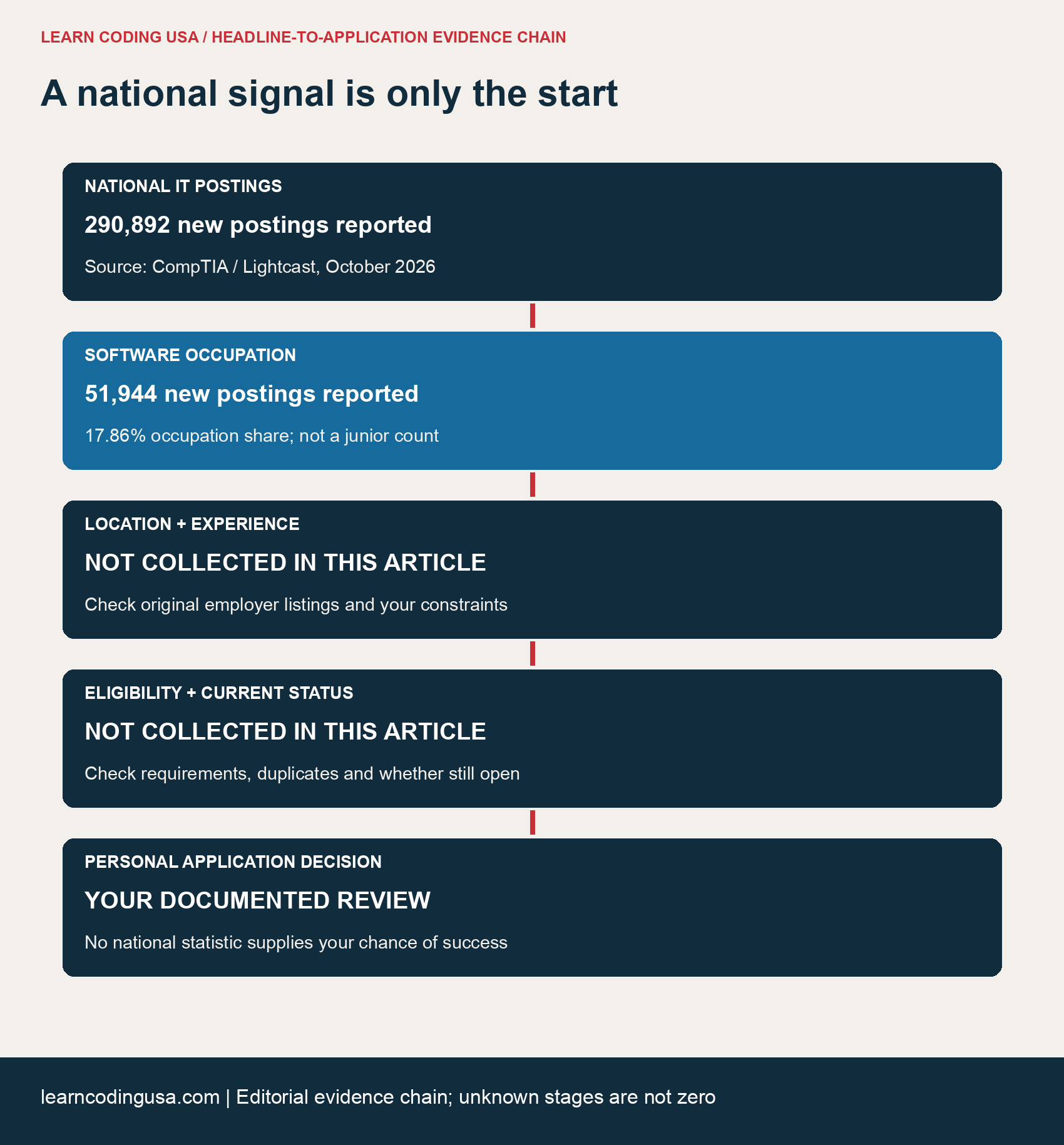
Record requirements as written. “Not stated” is different from “not required,” and “remote” may still restrict the worker’s location. Keep any authorization or sponsorship requirement tied to the specific listing. Do not infer eligibility from a job title or a company’s reputation.
Look for an original requisition identifier before counting duplicates. The same role may appear on several boards or in several locations. Set a rule for how you treat those copies, and retain the original URLs. Otherwise, a personal audit can reproduce the same measurement problem it is meant to solve.
For an introduction to role types and search preparation, see our entry-level coding jobs guide. This dated research page addresses measurement; that evergreen guide covers where a beginner can start.
Use the blank 50-listing audit without inventing results
The downloadable worksheet has fifty blank rows. We have not conducted the proposed fifty-listing pilot. The rows are a planning resource, not a dataset of observed vacancies. No employer is ranked and no applicant outcome is recorded.
Before collecting anything, define the role family and the date window. Predeclare which employer sites you will inspect and in what order. Record excluded listings as well as retained ones. A convenience sample from selected employers remains a convenience sample, even if every row has been checked carefully.
Use separate fields for experience, degree requirements, skills and salary disclosure. Document missing information rather than guessing. Then make an eligibility decision with a short reason, retaining the evidence needed to review it later. Recheck whether the listing is still open before applying.
Only after collection should you summarize recurring requirements. For example, you might identify which test frameworks appear repeatedly within your selected listings. That can guide a bounded project, but it cannot establish the skills demanded by the entire national market. Our portfolio evidence audit explains why an inspectable deliverable is more informative than an activity count alone.
Download the source ledger and applicant tools
The files distinguish published metrics, our arithmetic and an unexecuted research protocol. The blank audit contains no personal information. These CSVs are data and planning templates; they do not submit applications or automatically calculate spreadsheet formulas.
- October 2026 source-metric ledger (CSV)
- Software occupation-share calculation (CSV)
- Blank 50-listing vacancy audit (CSV)
- Proposed vacancy-pilot protocol (CSV)
Methodology, citation and revision notes
Learn Coding USA checked the original CompTIA release on 7 November 2026 and retained a dated source copy. We transcribed eleven metrics with units, populations and comparison periods. We calculated the software occupation share and its other-IT remainder, then checked the figures against the prose, table and charts.
The underlying report landing page could not be opened during verification. We therefore attribute the figures to CompTIA’s distributed release and do not claim independent access to Lightcast microdata. BLS documentation supplies the survey-definition background; it does not validate an invented beginner hiring rate.
Suggested citation: Learn Coding USA, “US Software Developer Job Market 2026: What 51,944 New Postings Mean,” published November 2026, calculations from CompTIA’s 6 November release covering October 2026. Cite the primary release alongside this page when reusing its source figures.
The evidence supports a positive October posting signal with important limits. It does not prove a durable recovery, an AI-caused change or easier access for every new coder. Keep your next decision tied to current, eligible employer listings and an honest record of what remains unknown.


