




AI-assisted open source contributions still need an author who can explain the change and verify its behavior. Before submitting your first pull request, prepare evidence a human reviewer can use. A generated patch is a starting point for investigation, not proof that the problem is solved.
Checked October 25, 2026. New Linux Foundation research gives this learning task a timely context. The findings are self-reported, with different respondent counts for different questions. Our contribution-evidence packet applies that research to a practical review exercise. It has not been validated in a trial.
For US students, career changers and junior developers, the immediate decision is whether a small change is ready for review. You do not need to submit more code to make the exercise worthwhile. You need to understand what changed, what you checked and which questions remain open.
What the survey says about AI-assisted open source contributions
The Linux Foundation report used an April–June 2026 web survey with 234 qualified respondents recruited through foundation and partner channels. This self-selected sample is not representative of US developers. Publication on October 20 does not make the fieldwork an October observation.
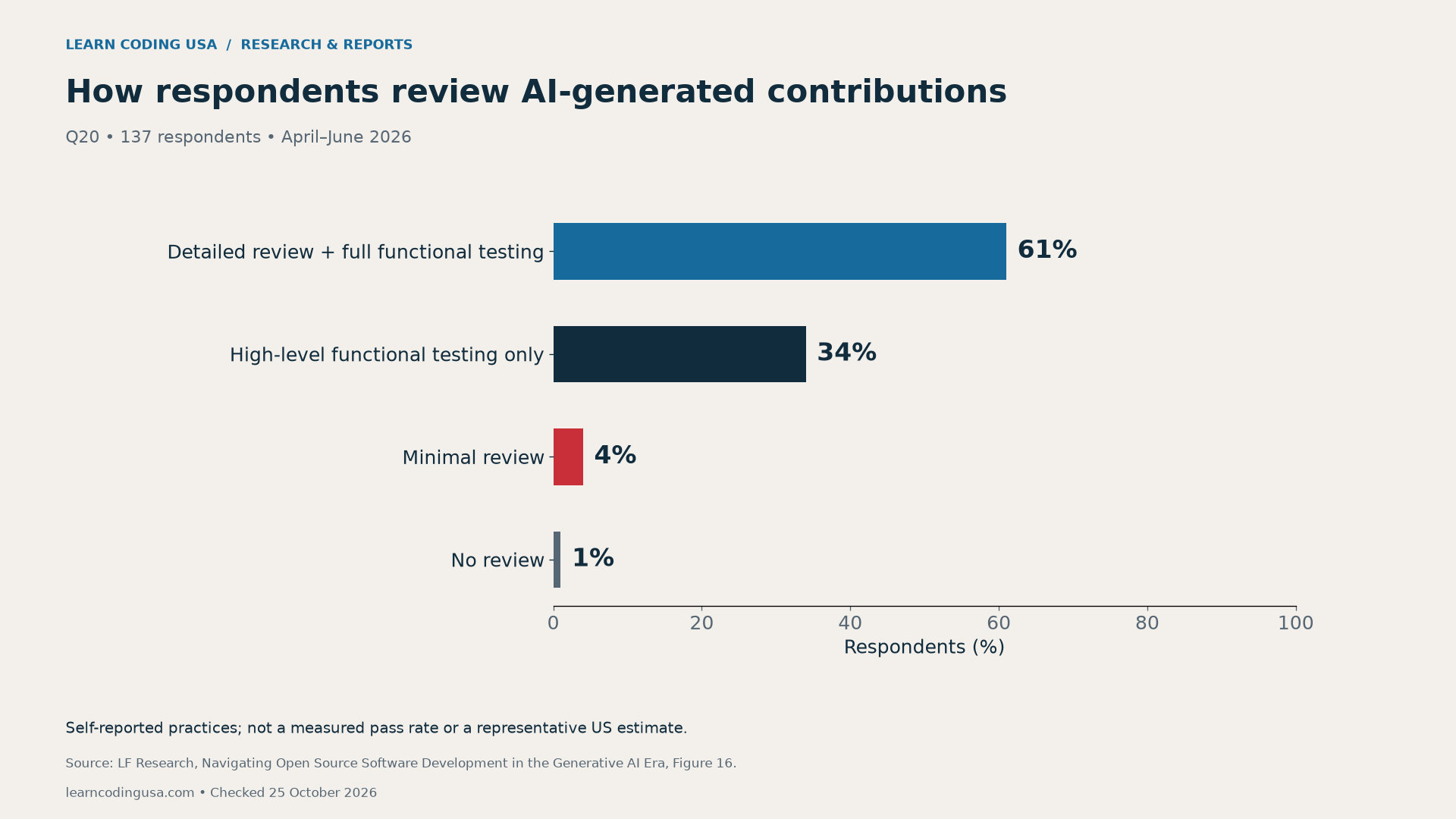
Question 20 has 137 respondents: 61% reported detailed review and full functional testing, 34% high-level functional testing only, 4% minimal review and 1% no review. These categories total 100%; they do not measure whether a particular contribution is correct.
Mentorship and speed answer different questions
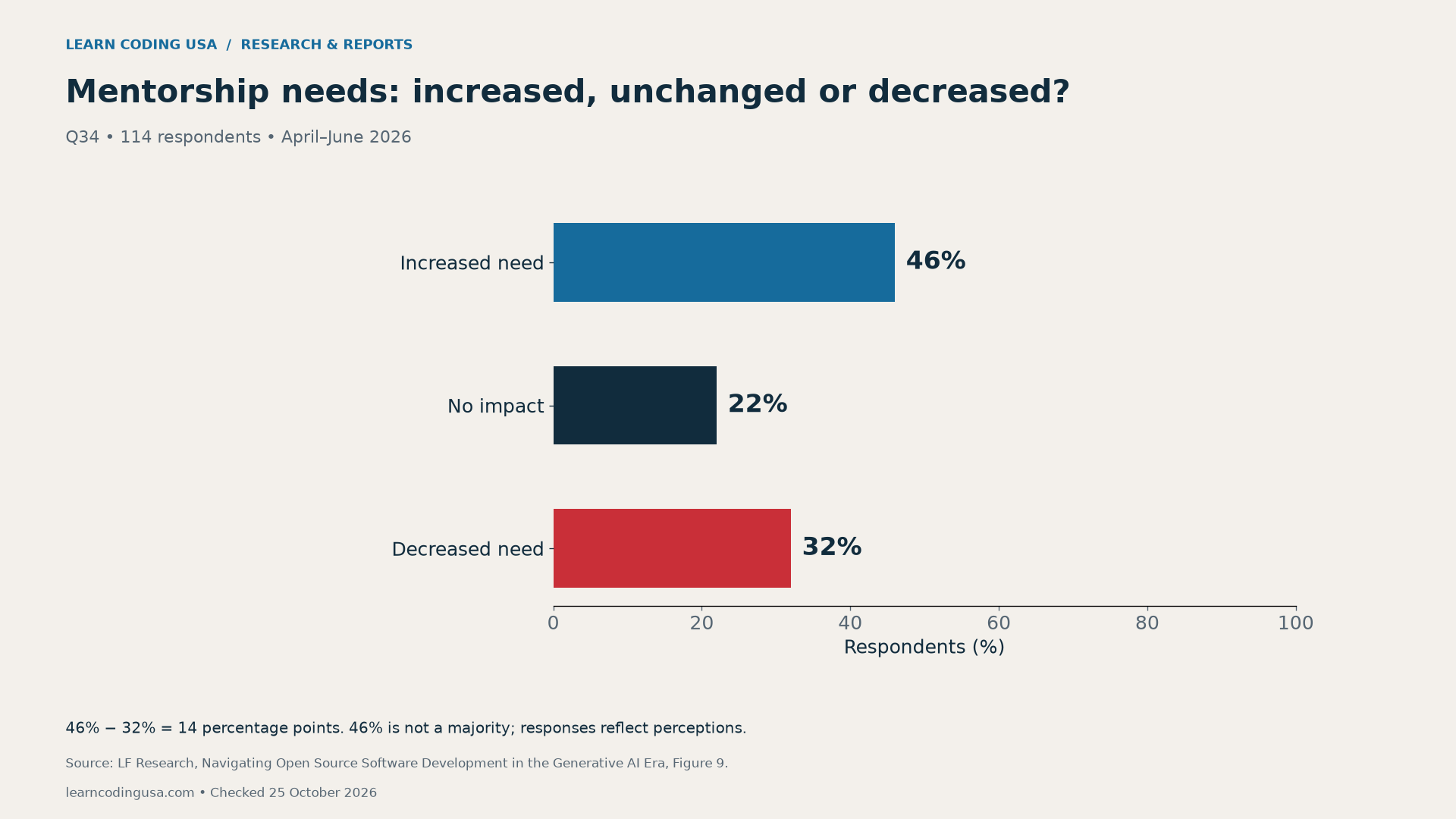
For mentorship, Q34 has 114 respondents: 46% perceived increased need, 22% no impact and 32% decreased need. Subtracting 32 from 46 gives 14 percentage points. That is a difference between response shares, not a measured change in mentoring hours.
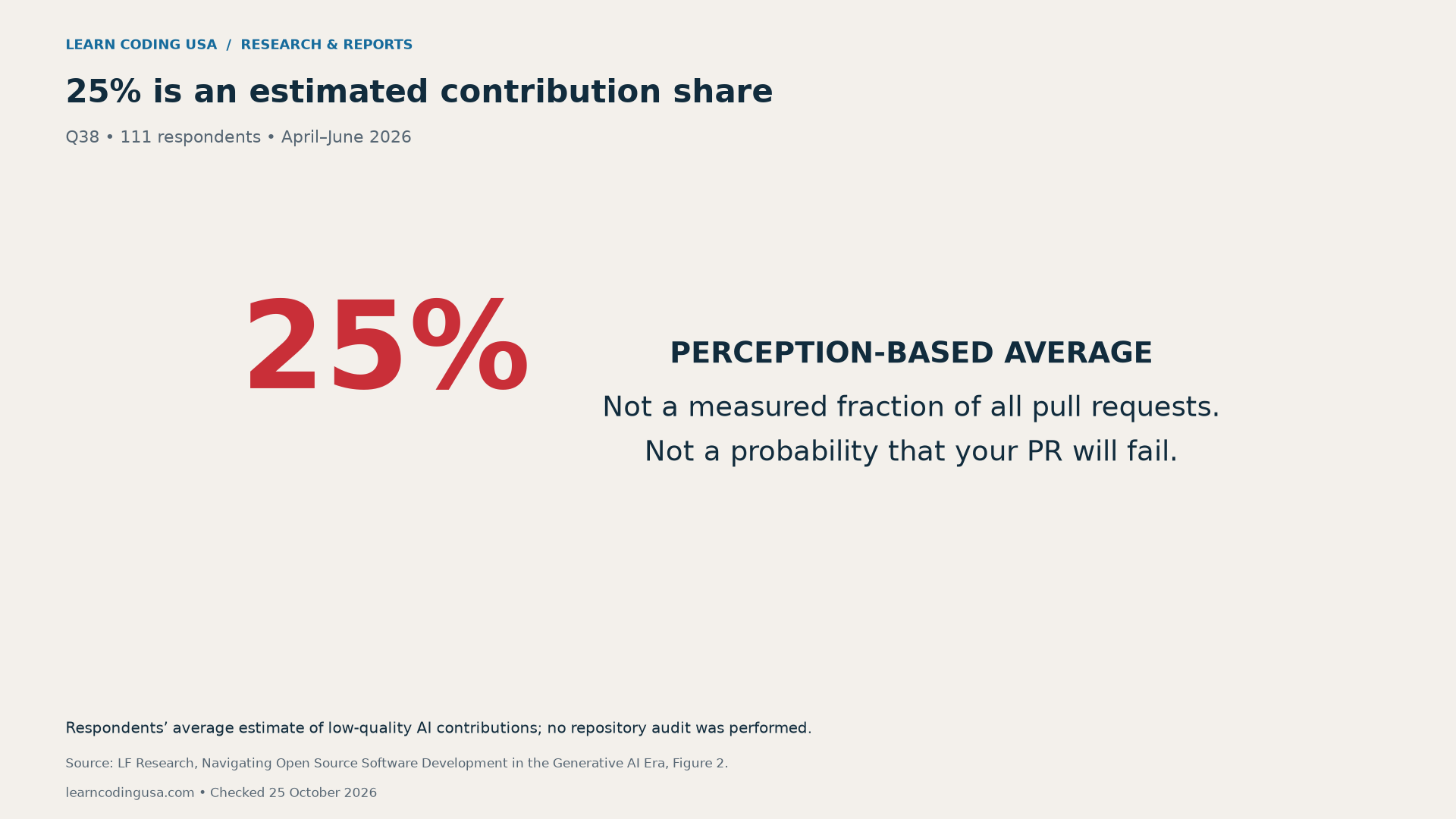
Q38’s 111 respondents estimated an average 25% share of low-quality AI contributions. No direct repository audit establishes a universal rate here. Do not combine these question denominators into one contribution success score.
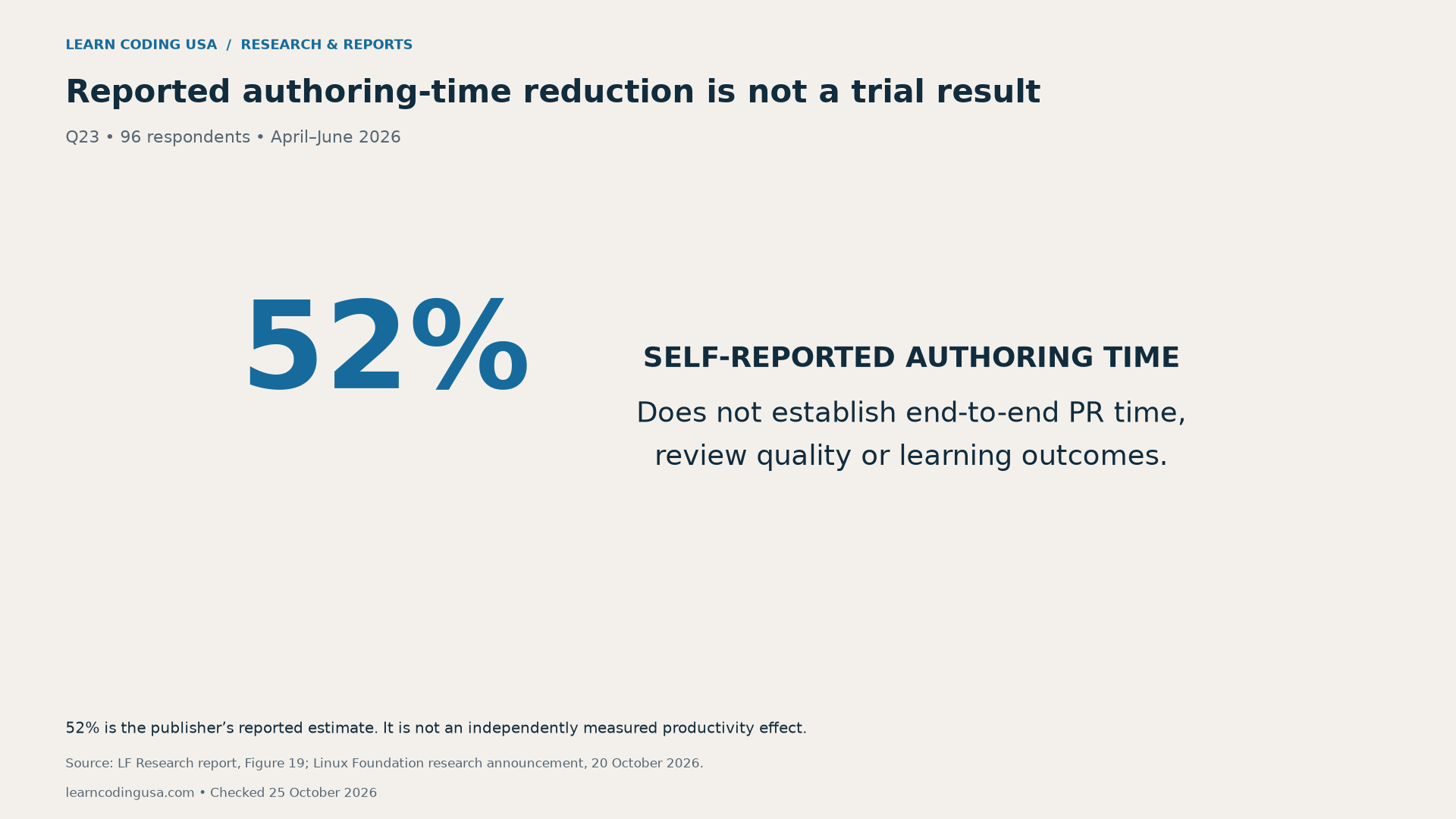
Separately, the October 20 research announcement highlights faster authoring. The report gives a 52% authoring-time reduction for Q23, with 96 respondents. We retain the publisher’s estimate. Self-reported authoring time does not establish end-to-end pull-request time, review quality or learning gains.
For a learner, faster drafting creates a question worth checking: can you account for the result? Treat a minute spent understanding a failure as useful work. Avoid judging the exercise only by generated lines, number of files or how quickly the first patch appeared.
Choose a change you can explain
Start with one behavior, one documentation error or another task within your current understanding. Read the surrounding code and reproduce the issue before changing it. If the task requires knowledge you do not yet have, narrow it or ask a focused question through the project’s normal channel.
GitHub’s contribution guide explains the normal project workflow. Read the repository’s own contribution instructions as well. A general guide cannot tell you whether a particular project accepts AI assistance, requires an issue first or expects specific tests.
Check the current AI-use policy before using a tool on project material. Record where you found the rule and when you checked it. If the rule is unclear, ask before assuming permission. Keep private repository content, credentials and personal information out of tools or public examples unless their use is authorized.
Prepare AI-assisted open source contributions for human review
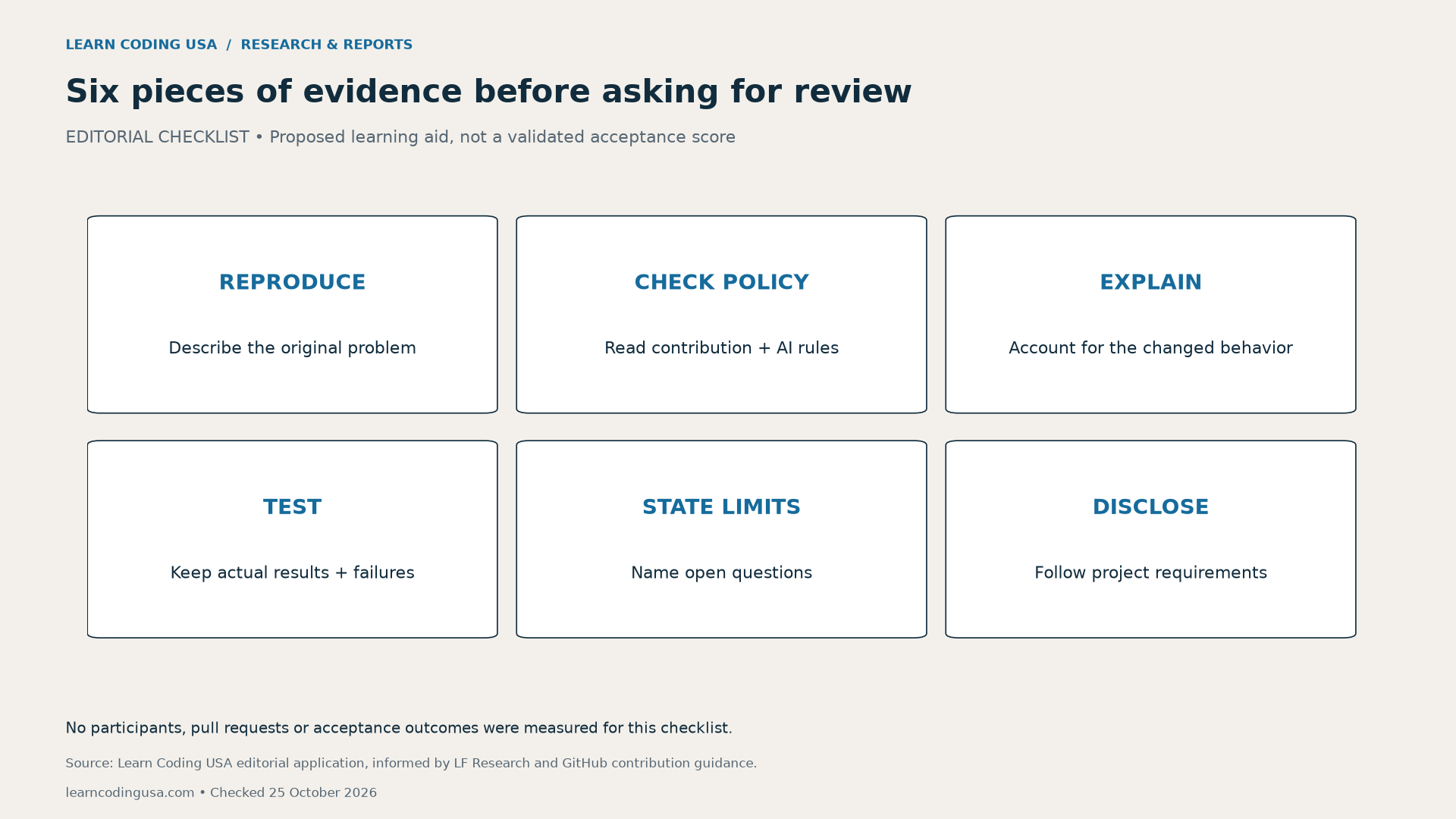
For AI-assisted open source contributions, our contribution-evidence template (CSV) has one blank row. Use it to collect links and actual observations before writing a submission. A blank field is an open task. Filling it with an intended result would conceal what still needs checking.
| Evidence | Useful record |
|---|---|
| Problem | Steps and expected versus observed behavior |
| Policy | Current contribution and AI-use requirements |
| Explanation | Why this change addresses that behavior |
| Tests | Checks run, results and relevant failures |
| Limits | Unrun checks and unresolved questions |
| Disclosure | Assistance described as the project requires |
First, preserve a minimal description of the original behavior. Record the project commit and relevant environment. Next, explain the change in your own words. Identify the function, condition or document section that matters. If you cannot explain a generated line, investigate it before asking a maintainer to accept it.

For example, a proposed fix may change how a function handles an empty input. Explain the intended output and why the existing branch misses it. Then describe the check you actually ran. Do not paste an invented passing result into the packet. The example illustrates a reporting habit; no repository was tested for this article.
Tech Consulting Tailored to Your Coding Journey
Get expert guidance in coding with a personalized consultation. Receive unique, actionable insights delivered in 1-3 business days.
Get StartedTest behavior and report the limits
Use the project’s documented test process in a trusted environment you control. Record the exact check, its result and the relevant context. Include failure cases that match the change. Preserve failures rather than removing them from the summary. Ask the project for guidance when a required check cannot run.
GitHub’s review-preparation guidance recommends focused changes, context and self-review. Apply that principle by reading the final diff yourself. Remove unrelated edits and confirm the description matches the files. Review any AI-generated summary instead of treating it as authoritative.
Keep “not run” separate from “passed.” Also separate a passing test from a complete safety claim. Tests cover the behavior they exercise; a successful command cannot settle every compatibility or security question. Name those limits plainly so a reviewer knows where attention is still needed.
Request focused feedback and record what you learned
Write a short summary of the problem, the intended change and the evidence. Link to the relevant issue when the project expects one. Describe assistance according to the project’s requirements. Include one specific question if you need feedback, such as whether a failure case matches the project’s intended behavior.
A maintainer may request revisions, suggest another approach or decline a change. Record the reason and what you learned. A merged pull request is not the only useful outcome of the exercise. Avoid turning this checklist into a promise of acceptance, employment or a particular learning gain.
For background, read our open-source projects as learning resources guide. Our code-verification guide beyond AI suggestions provides broader review context. This report adds a concrete evidence packet to use with the current rules of the project you choose.
Download the reference and understand the method
The survey reference values (CSV) transcribe the published percentages, question counts and units. We check the two response distributions sum to 100 and calculate the mentorship-share difference. We did not analyze respondent-level microdata, recruit participants or measure pull-request outcomes.
The five visuals use our own designs. Published findings and our proposed checklist remain separate. A future exercise could record drafting, verification and rework minutes, but none were measured here. Recheck project policies and the source report when using this dated reference.
Suggested citation: Learn Coding USA, “Your First AI-Assisted Open-Source Pull Request: What to Verify Before Submitting,” checked October 25, 2026. Cite Linux Foundation Research for survey findings and this report for the derived percentage-point difference and reusable evidence template.


