







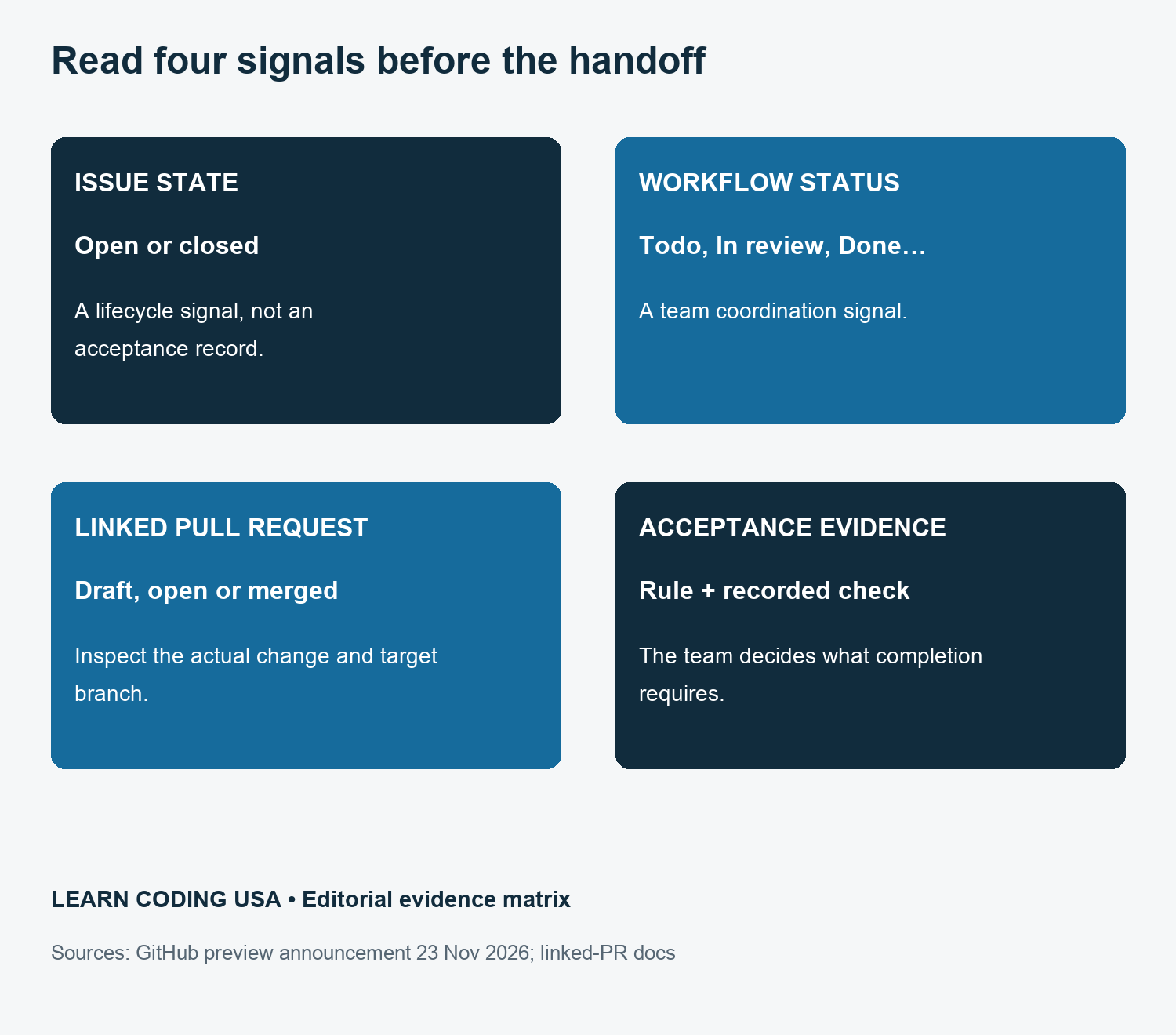
GitHub issue statuses can show that work is in review without proving it is accepted. A board card, an issue’s open or closed state, a linked pull request and a team’s acceptance record answer different questions. Read them together before reporting that a feature is complete.
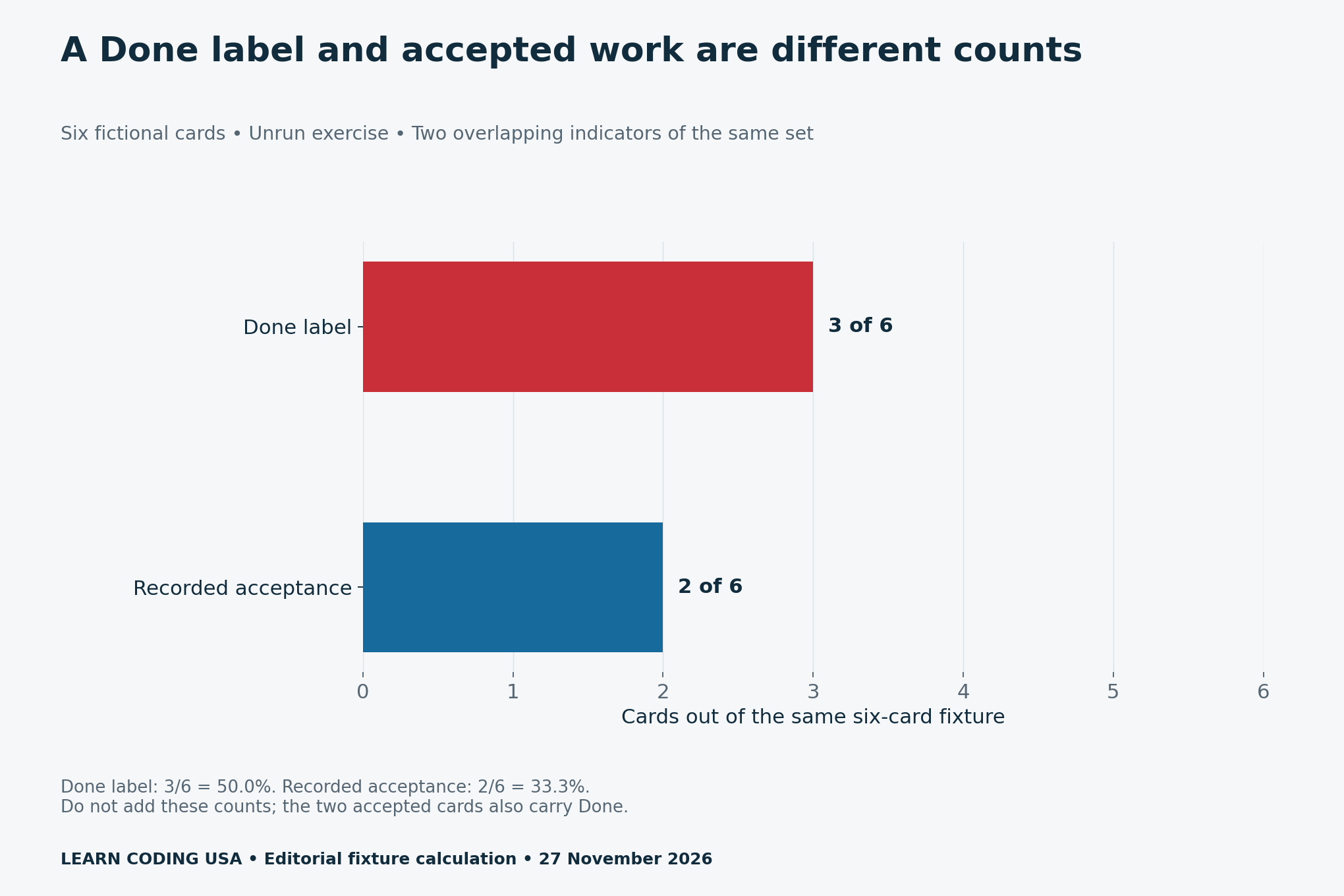
Our six-card exercise makes that distinction visible. Three fictional cards carry Done, but only two meet the exercise’s stated acceptance rule. The figures describe a constructed teaching example. We have not run these cards through GitHub or measured how often real teams move work too early.
GitHub issue statuses and repository boards: what is new?
GitHub’s 23 November public-preview announcement introduces issue-level statuses and repository board views. It describes automatic transitions: linking a draft PR moves an issue to In progress; a ready-for-review or linked open PR moves it to In review. Matching Projects status values can synchronize in both directions.
The preview also allows manual status changes and board movement. Treat these as coordination tools. The announcement does not establish that your own acceptance checks passed. Preview behavior may change, so verify availability and the actual event history in a disposable repository before relying on a team-specific automation.
Define accepted before counting completed cards
For this exercise, a card meets acceptance only when its acceptance check is explicitly recorded. We deliberately keep that rule separate from the board label. A real team should replace it with its own clear requirements, such as a tested user journey, an approved change and a named reviewer’s recorded decision.
Write the rule before sorting the cards. Otherwise, an attractive board column can become the definition after the fact. Keep the same denominator throughout the comparison: all six cards in this synthetic snapshot. Do not quietly exclude the manually moved card or the custom-status mismatch because they complicate the headline.
| Card | State / status | Linked PR | Acceptance in fixture |
|---|---|---|---|
| A | open / In review | open | not recorded |
| B | open / Done | none | not recorded |
| C | closed / Done | merged | acceptance check recorded |
| D | closed / Done | merged | acceptance check recorded |
| E | closed / In progress | merged | not recorded |
| F | open / Todo | none | not recorded |
Card A is in review with an open pull request, yet no acceptance record. Card B has been manually moved to Done while its issue remains open. Neither earns an acceptance count under our rule. The point is to make the missing evidence visible, rather than guessing whether the work is probably finished.
Cards C and D include acceptance records. Card E has a merged PR but no acceptance record, while its custom Project value is Released and its issue status is In progress. That mismatch is an exercise condition, not an observed synchronization failure. Card F has no linked PR and remains Todo.
A merged pull request is another evidence layer
GitHub’s linked-pull-request guidance explains how links and closing keywords connect an issue to a change. It also distinguishes the repository’s default branch: closing-keyword behavior depends on that target. Check the actual link and branch instead of assuming that any reference or merge closes the issue.
Even when closure behaves as configured, a team may need a separate acceptance step. For example, an instructor can require a student to demonstrate the corrected behavior using agreed inputs. A closed issue does not supply that demonstration on its own. Keep the evidence beside the card so the next person can inspect it.
Try the exercise without creating misleading metrics
First, copy the six-card CSV into your teaching notes and ask learners to count Done labels. Then give them the acceptance rule and ask for a second count. The disagreement should prompt a discussion about evidence, not a claim that a real software team has a particular defect rate.
Next, use the blank handoff ledger in a disposable repository if you choose to test the preview. Record what changed, who or what caused it, and when you observed it. Include the Project value verbatim. A custom label that looks similar may still need an explicit mapping check; do not fill an unobserved outcome with an expected result.
Finally, compare the event history with the snapshot. A screenshot shows the current arrangement, while the history helps explain how it arose. If you cannot identify the cause of a status movement, mark it unknown and investigate before changing an automation. Retain earlier observations rather than overwriting them with a cleaner-looking result.
Download the six-card teaching pack
- Six-card unrun exercise (CSV)
- Synthetic label and acceptance counts (CSV)
- Blank issue handoff ledger (CSV)
- Primary sources and boundaries (CSV)
For related checks, read our code review tools guide and coverage upload diagnostic. They also separate a tool’s visible signal from a stronger conclusion about the underlying work.
Method and limitations
Sources checked on 27 November 2026. We read the official preview announcement and linked-PR documentation, created six fictional records and checked their counts locally. The exercise is unrun. Its manually moved card and custom-status mismatch are deliberate teaching conditions, not evidence of a GitHub defect or a measured project outcome.
Tech Consulting Tailored to Your Coding Journey
Get expert guidance in coding with a personalized consultation. Receive unique, actionable insights delivered in 1-3 business days.
Get StartedSuggested citation: Learn Coding USA, “GitHub Issue Statuses: When In Review Is Not Done”, 27 November 2026. Retain the unrun-fixture qualification and acceptance definition with any reused count.


