







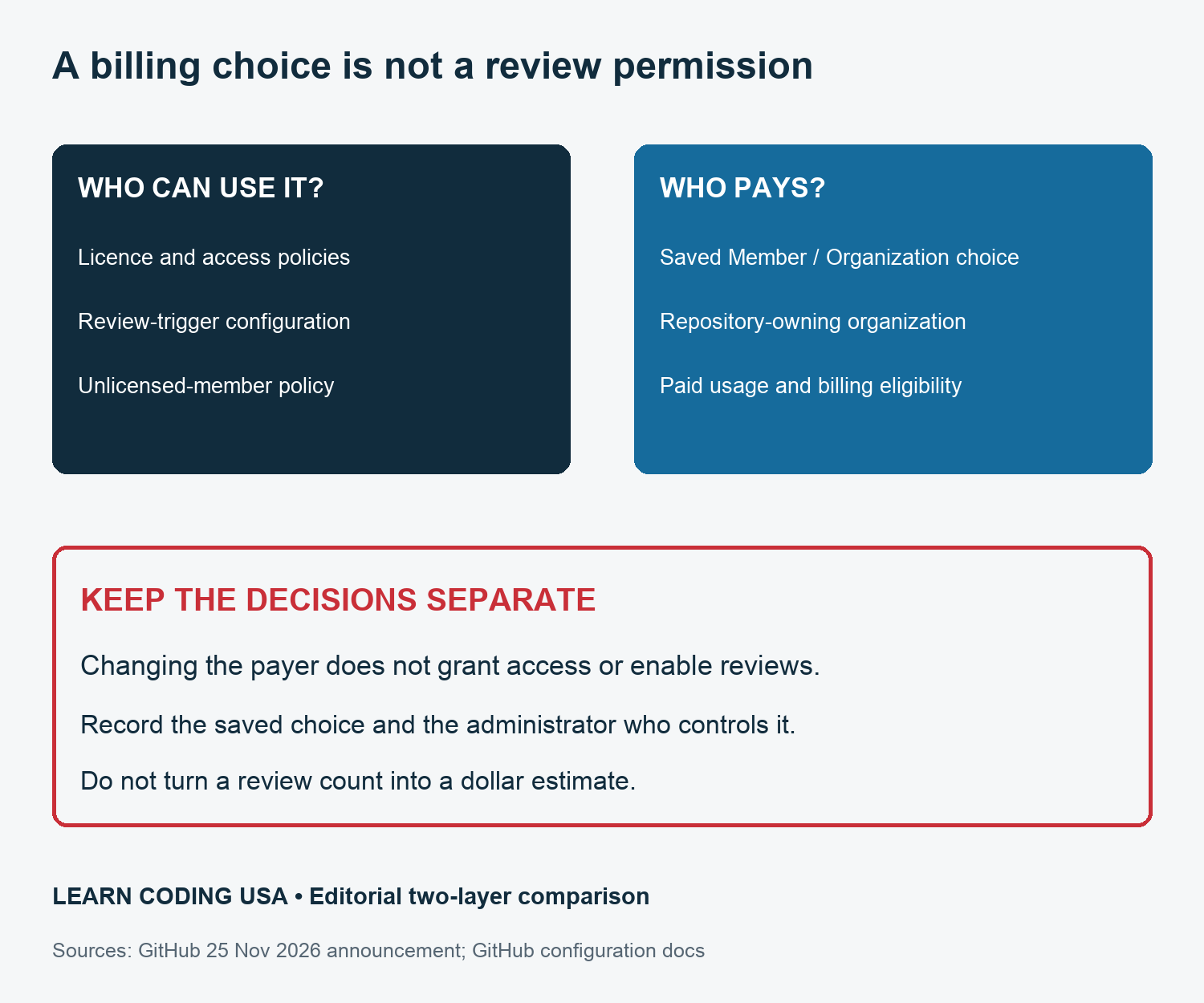
GitHub Copilot review billing is a question about who pays, not proof that a review is free. Before the announced 30 December 2026 default change, maintainers should record the saved billing choice, the repository owner and the administrator who controls that choice. A review count alone cannot answer those questions.
Our four-case worksheet routes the same fictional set of 12 covered reviews under different settings. It is a policy illustration, not measured account usage, a price quote or a forecast of your bill. The downloadable ledger helps a team collect its own evidence without copying private billing details into a public issue.
GitHub Copilot review billing: the announced change
GitHub’s 25 November announcement schedules the default transition for 30 December 2026. For eligible Business and Enterprise organizations without a saved choice, covered licensed-member reviews move from member entitlement to the repository-owning organization. Explicit Member and Organization selections remain in place.
The announcement lists exceptions: no AI credits paid usage, a billing lock, or no billable customer leads to Member instead. The separate unlicensed-member policy does not change. An enterprise-controlled setting requires enterprise action. These are eligibility boundaries, not evidence that a particular account has already changed.
Separate the billing date from the documentation date
Research was checked on 27 November 2026, before the announced transition. The living configuration documentation already describes Default as organization billing. Read that alongside the dated announcement rather than assuming every displayed documentation default is already active in your own account. Retain the date and exact saved value from the account you administer.
The documentation distinguishes Member entitlement from Organization billing and says an enforced enterprise choice cannot be overridden at organization level. Organization billing requires AI credits paid usage. It also says the billing choice applies to manual and automatic reviews without granting access or enabling unlicensed members. Check these controls separately.
Four cases using 12 hypothetical reviews
Hold the review count constant to see the routing difference. Each row below represents its own example organization and its own 12 covered licensed-member reviews. The rows are alternatives. Adding them into a claim about 48 real reviews would misrepresent the model.
| Independent case | Before transition | After announced transition |
|---|---|---|
| Eligible unset choice | 12 member / 0 organization | 0 member / 12 organization |
| Explicit Member | 12 member / 0 organization | 12 member / 0 organization |
| Explicit Organization | 0 member / 12 organization | 0 member / 12 organization |
| Unset; paid usage off | 12 member / 0 organization | 12 member / 0 organization |
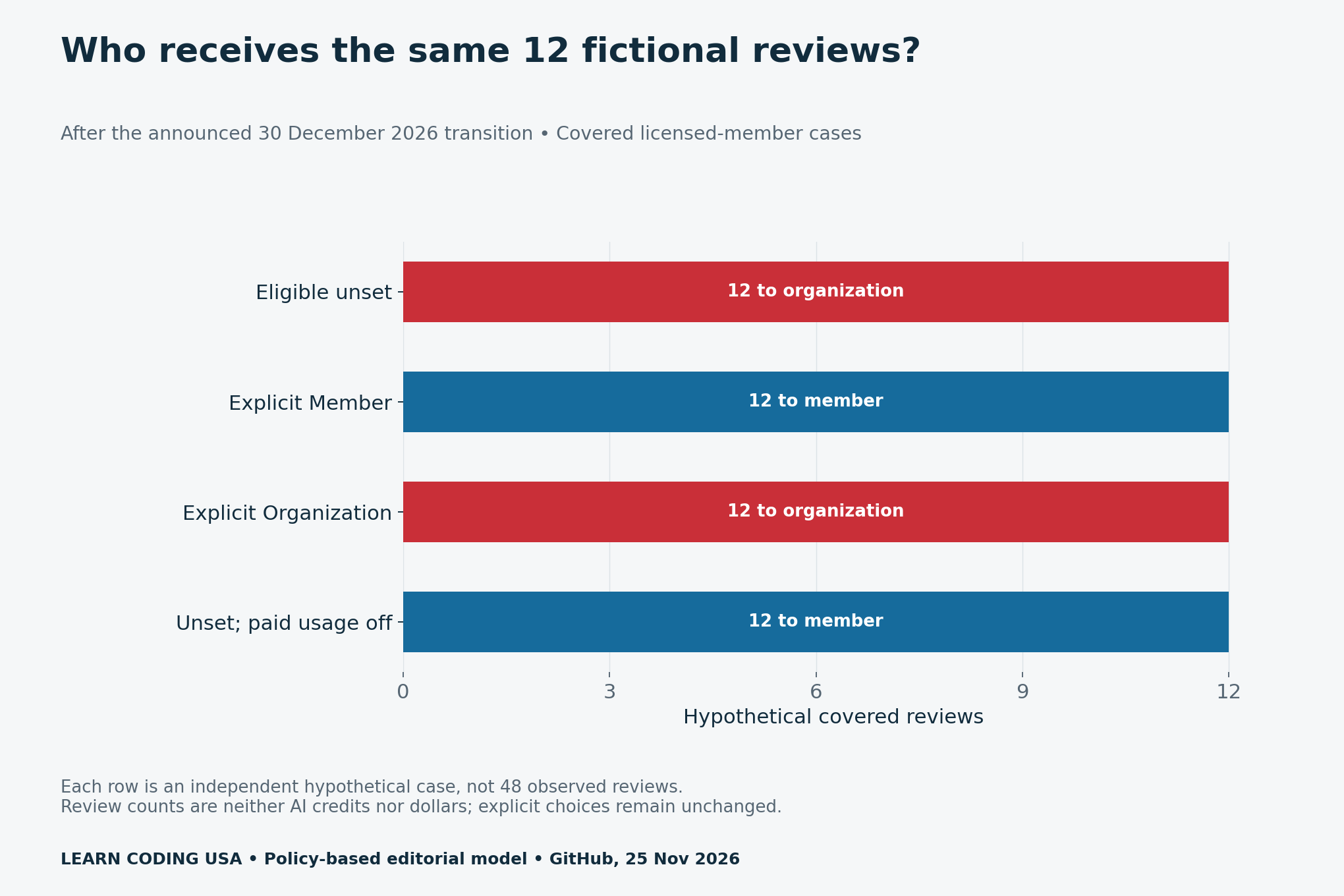
For the eligible unset case, the modeled organization share changes from 0 of 12 to 12 of 12. That is a routing calculation: 0% becomes 100% under the stated assumptions. It is not a 100% price increase. A percentage of reviews and a percentage change in money use different denominators.
Meanwhile, an explicit Member choice stays on the member route in this model. Do not interpret that as unlimited review capacity. Check entitlement and actual usage separately. Likewise, the Organization row says where covered usage is billed; it does not claim that every review consumes an identical amount or that all repositories have equal activity.
Build a small evidence ledger before changing a setting
Start with one repository and identify its owning organization. Then ask the authorized administrator to record whether the choice is explicit or unset. Keep an observation such as “Member saved on 27 November” separate from an inference such as “we expect this team to stay on member entitlement after the transition.”
Next, identify who can make the decision. A repository maintainer may understand the workflow but lack authority over enterprise billing. Record the responsible owner and a review date. If the organization cannot confirm a required condition, mark it unknown instead of treating a missing answer as an enabled feature.
Finally, compare the ledger against a current, authorized view of usage. Avoid publishing account identifiers, payment details or private repository names in a shared troubleshooting report. The blank CSV intentionally contains no real customer data. This research did not inspect or change a GitHub account’s billing controls.
Keep review triggers and spending evidence distinct
A useful handoff has two parts: the policy decision and the observed usage. A team might document its intended payer correctly while misunderstanding which workflows request reviews. Conversely, a review appearing on a pull request does not establish which budget ultimately absorbed its usage. Collect evidence for each question.
When reviewing the process, retain the relevant settings date, repository owner, decision owner and the scope of the covered members. Use the first actionable discrepancy to guide a follow-up. Do not change access, automatic review triggers and billing together merely to make a single test produce a different result.
For the broader review workflow, see our guide to using code review tools. For another example of keeping tool outcomes separate, our coverage-upload diagnostic distinguishes passed tests from an accepted report and a displayed percentage.
Tech Consulting Tailored to Your Coding Journey
Get expert guidance in coding with a personalized consultation. Receive unique, actionable insights delivered in 1-3 business days.
Get StartedDownload the policy model and blank ledger
- Four policy scenarios (CSV)
- Fictional review-routing calculations (CSV)
- Blank billing-choice evidence ledger (CSV)
- Primary sources and scope (CSV)
Method and limitations
We compared the dated GitHub announcement with its configuration guidance, then constructed four independent policy cases. Python checks confirm that member plus organization counts equal 12 in every case. No GitHub review was run, no account was queried and no spending was measured. The source announcement governs the stated transition date; recheck official guidance before acting later.
Suggested citation: Learn Coding USA, “Copilot Code Review: Whose Budget Pays After December 30?”, 27 November 2026. Retain the hypothetical-count and future-transition qualifications when reusing the chart.


