




Use junior developer mentorship interview questions to find out how a team actually supports learning. Ask for a responsible reviewer, a recent feedback example and time to practise. “We encourage growth” can start a conversation, but it does not explain who helps when you get stuck.
Our original eight-question worksheet turns that conversation into an evidence record. It uses three descriptive states: specific evidence, general assurance and not established. It does not calculate a numerical employer quality score. Two fictional examples show how to ask a useful follow-up without mistaking a reassuring answer for a verified arrangement.
The news hook is Adaptavist’s November 2026 survey coverage. Its 1,000 respondents span five countries, and fieldwork took place in March. These are pooled perceptions, not a US-only assessment or a test of any employer you are considering.
Read the benefits and learning concerns together
The 4 November Adaptavist research release reports that 63% felt AI reduced learning through hands-on coding, while 43% reported fewer learning opportunities. It also reports concern about junior dependence on automation.
However, the company’s 5 November explanation adds important balance: 83% said AI improved their productivity, and 81% felt better at their jobs. A respondent can see a benefit and still worry about learning. The percentages are not mutually exclusive groups.
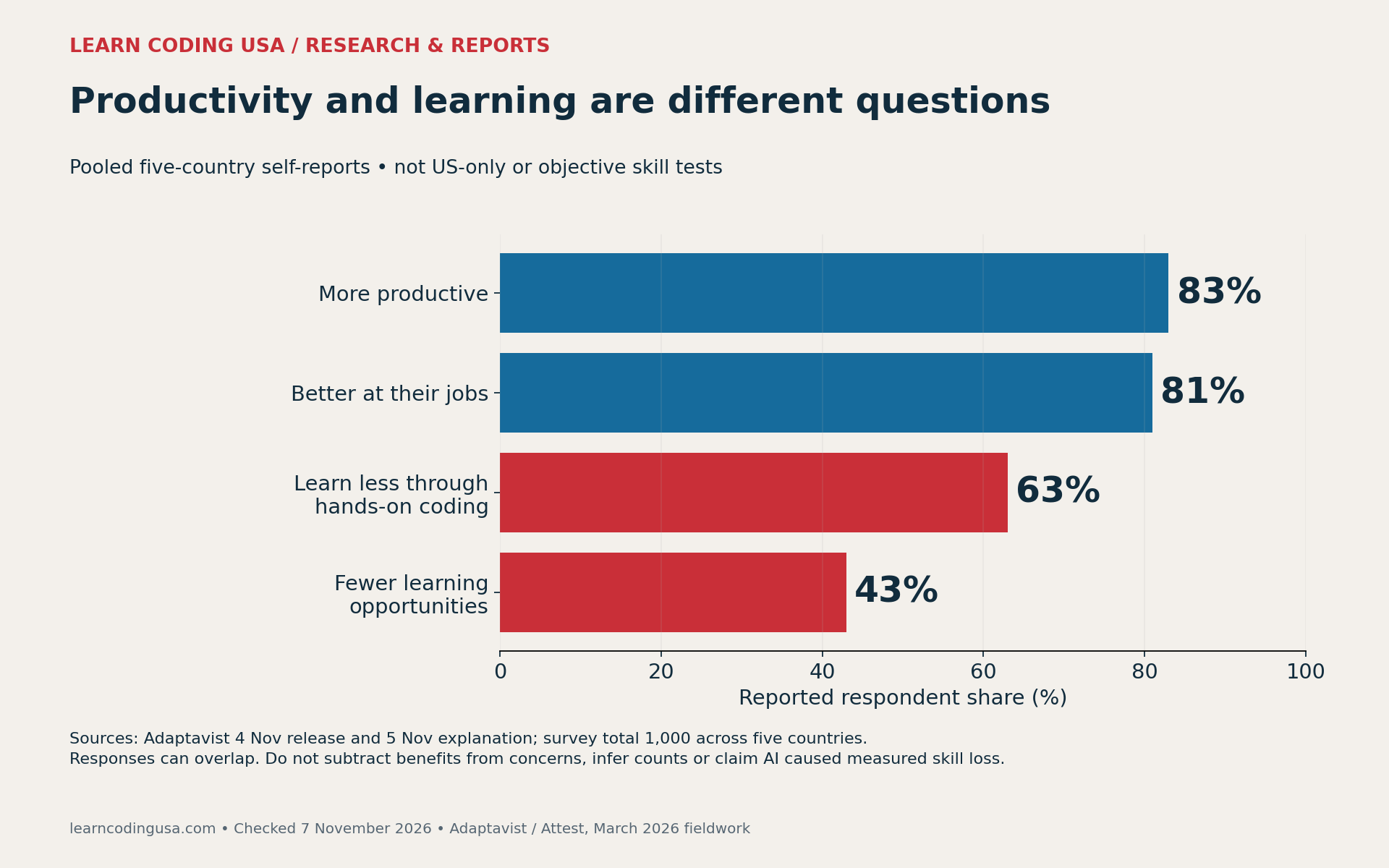
For a candidate, the useful implication is a question about the employer’s learning process. It is not a reason to assume that every AI-using team fails to mentor. Ask how the team combines faster production with opportunities to explain, test and revise a change yourself.
Our US software job-market analysis addresses whether national posting activity establishes an opportunity for an individual applicant. This article asks a different question: what support exists after you join a particular team?
Career-stage figures are not a forecast for you
The release reports negative career-progression perceptions of 26% among early-career respondents, 35% at mid-career and 27% among experienced respondents. The public material does not disclose those subgroup sizes or the US subsample.
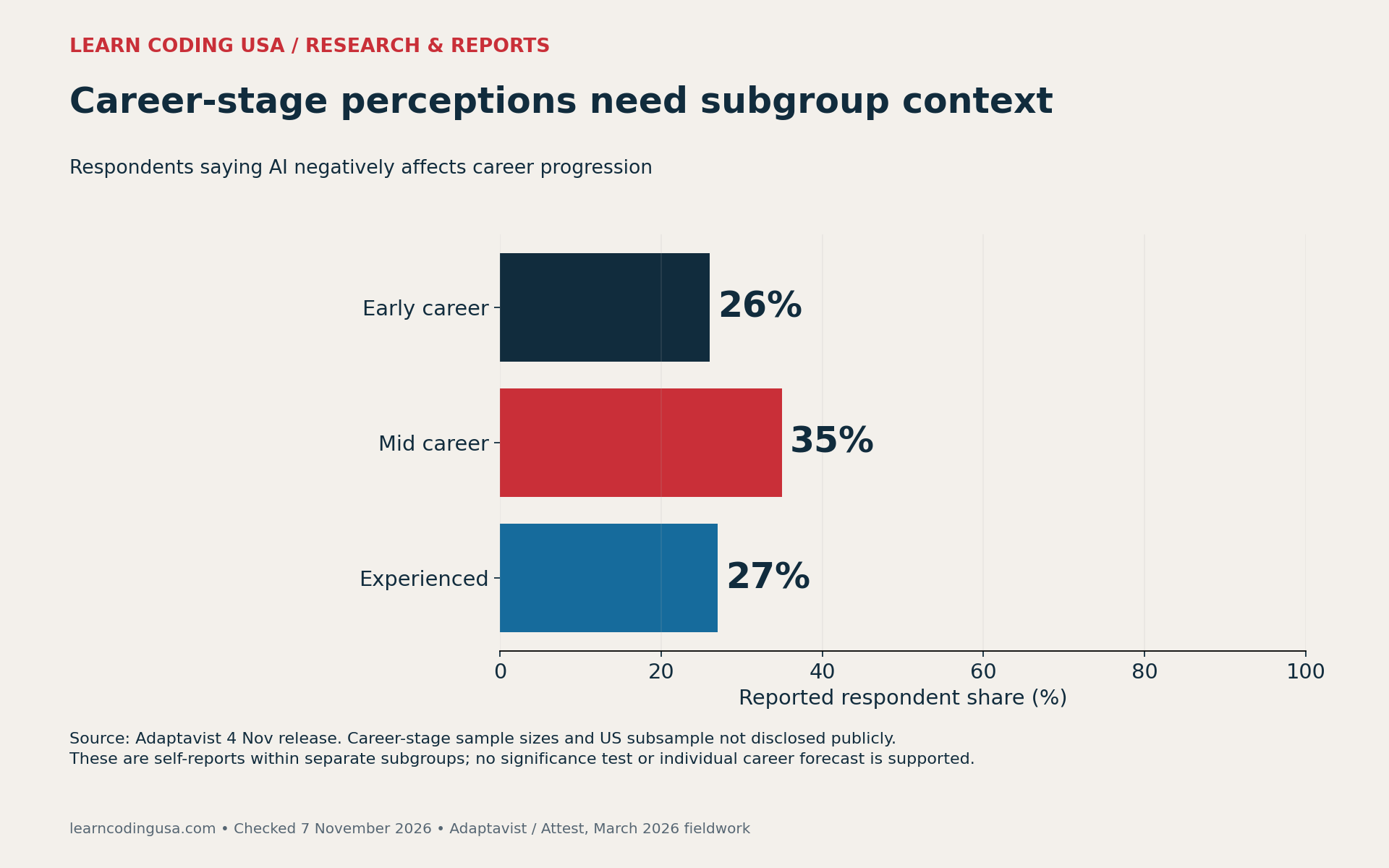
Consequently, the chart cannot establish that one career stage has a statistically greater risk or that a particular offer will slow your progress. Use it to motivate a concrete discussion about progression criteria. Then investigate the team’s actual examples.
Eight junior developer mentorship interview questions
The worksheet pairs each question with evidence to request and a follow-up. You can use it during an interview, an offer discussion or an early check-in. Choose the questions that fit the conversation rather than reading them as a rigid script.
1. Who owns mentoring and covers an absence?
Ask who is responsible for your technical mentoring and who covers their absence. A named role or person gives you a clearer route than a general statement that everyone helps. Then ask who would follow up on a blocked task when the usual reviewer is away.
2. What does code review look like in a normal week?
Request a recent example of review for a new junior and a realistic cadence. You do not need confidential source code. Instead, ask how the reviewer explains a change, how you respond and what happens when delivery pressure makes reviewers busy.
3. Can you describe a supported debugging task?
Ask about a recent junior debugging issue and the guidance a colleague provided. An informative answer describes the process: what the junior investigated, what feedback arrived and what they changed next. It offers more context than simply saying the team has smart engineers.
4. How is learning time protected?
Ask who owns review and learning time when deadlines tighten. A useful follow-up concerns the last time that time moved or disappeared. A calendar slot can help, but the rescheduling process matters too. Confirm what is realistic for the role rather than demanding an arbitrary universal allowance.
5. Can a junior question an AI-generated change?
Ask how you should raise uncertainty or challenge an approach. Look for a route to a responsible human and an example of a question changing the plan. This concerns the team’s review process; it does not ask for unlimited authority over production systems.
Tech Consulting Tailored to Your Coding Journey
Get expert guidance in coding with a personalized consultation. Receive unique, actionable insights delivered in 1-3 business days.
Get Started6. What evidence counts in progression reviews?
Ask whether evaluations consider outcomes, explanations, tests, collaboration or tool usage. Request the criteria and a recent example. In particular, ask how the team recognises the work of reviewing and correcting generated code, rather than treating generation activity as complete delivery.
7. Which agent tasks can I delegate?
Clarify which tasks an agent can help with, which decisions require human approval and who helps when its output is uncertain. Also ask what training comes before that responsibility. “We use agents” does not explain the boundaries a new colleague must work within.
8. What happened for a recent junior on this team?
Ask for a concrete development example and the check-in process. Then discuss what you would review during your first month. One example is not a promise that your path will match it, but it can make the employer’s explanation easier to assess.
Agent management makes ownership worth clarifying
The same release reports that 68% saw agent management becoming an explicit daily responsibility and 82% regularly deployed multiple agents. Separately, 70% worried that juniors were becoming overly dependent on automation.
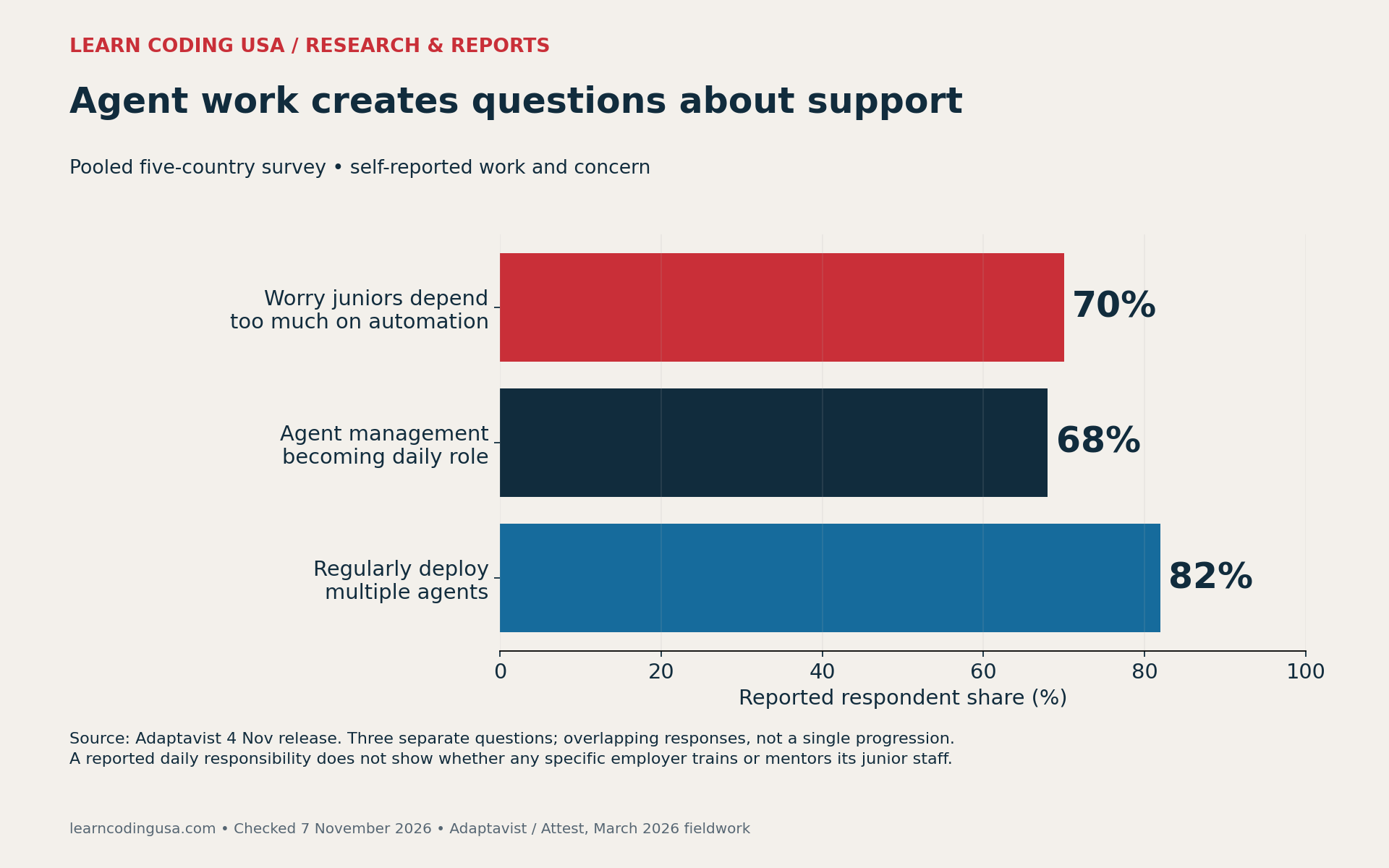
These findings make ownership a relevant interview topic. However, they cannot tell you whether the manager in front of you has a training plan. The interview worksheet therefore asks for that plan directly, including escalation and evaluation criteria.
Record the answer without inventing precision
Write down the answer and the evidence reference. Next, choose one of the three response states. Specific evidence names an owner, example or process. General assurance is encouraging but vague. Not established means the detail remains unknown.
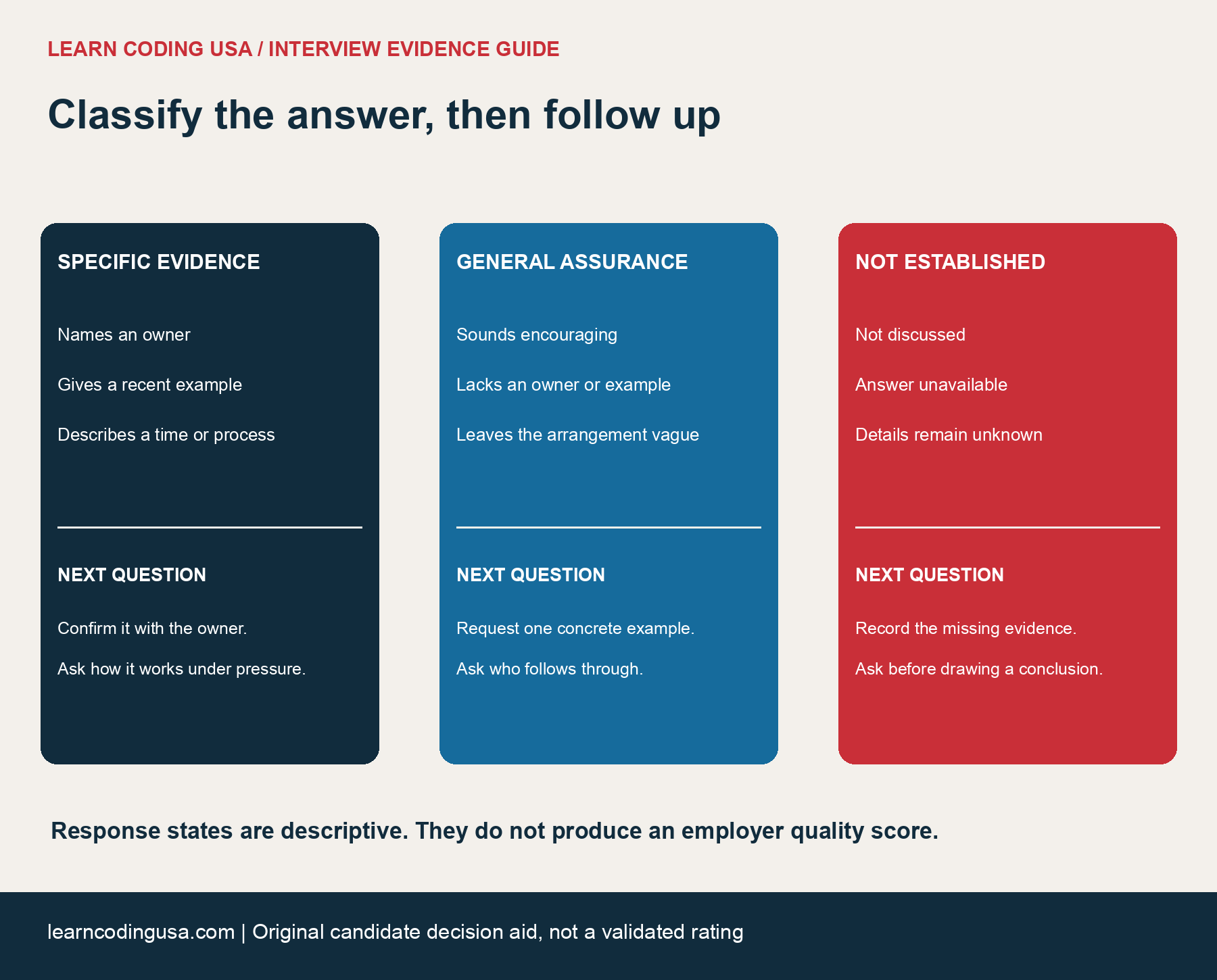
An answer can move between states after a follow-up. For example, an interviewer may initially say everyone helps, then identify a reviewer and explain the normal review slot. Conversely, a specific promise still needs confirmation. Detail alone does not make a statement independently verified.
Avoid adding the states into a total or awarding points. We have not validated weights, thresholds or predictive accuracy. A numeric ranking would imply evidence the worksheet does not contain.
Two fictional answers to the same reassuring promise
Both fictional teams say they support junior learning. Team A names a reviewer and backup, describes a learning block’s rescheduling owner and offers progression criteria. Team B says everyone helps in chat and learning happens in spare moments; progression criteria were not discussed.
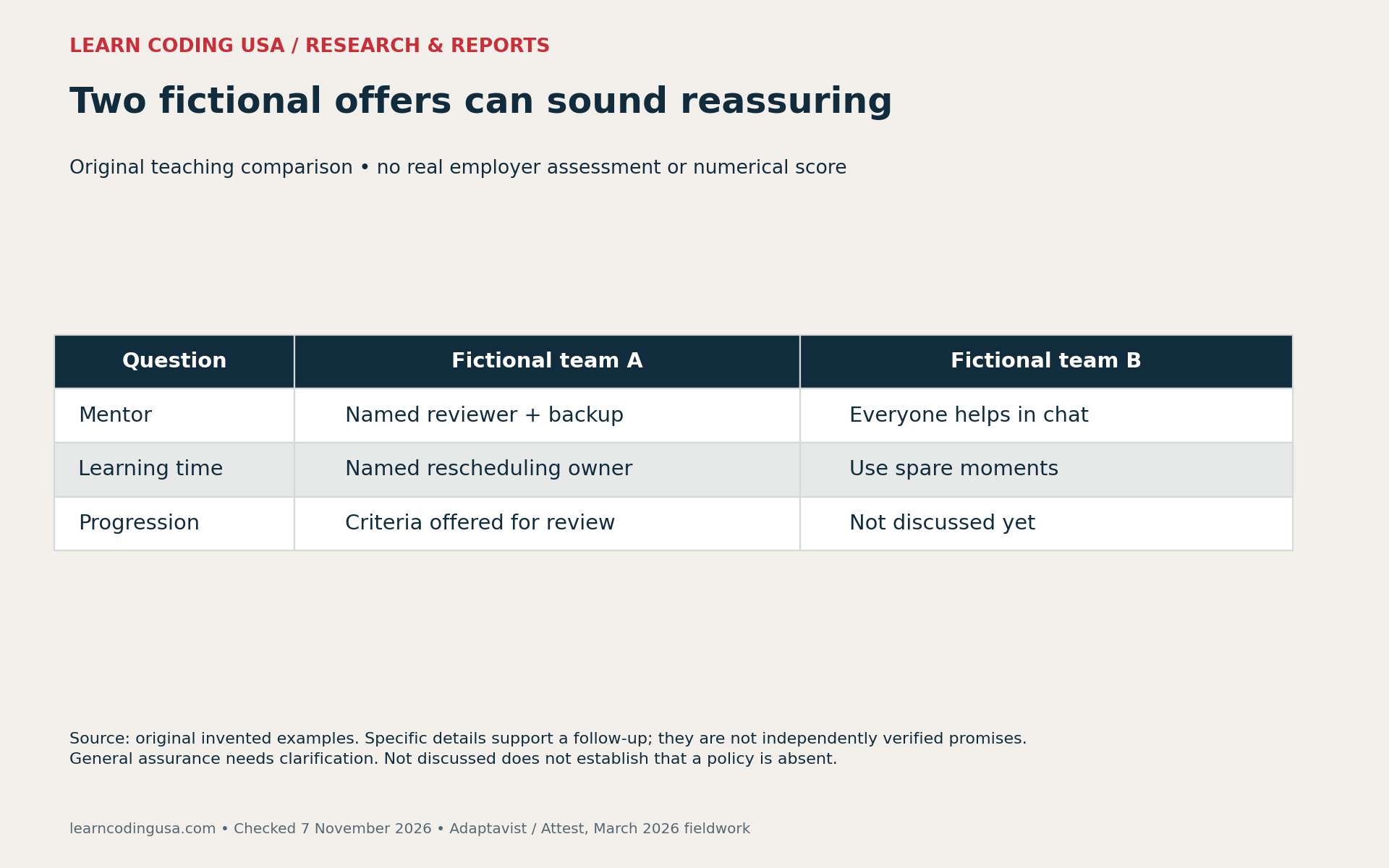
Team A supplies more concrete material to confirm. Team B needs follow-up questions. Neither row tells you what the workplace is truly like. In particular, “not discussed” does not prove a policy is absent or that staff are unwilling to help.
The candidate must also consider role scope, pay, working arrangements and personal constraints. These junior developer mentorship interview questions illuminate one part of that decision. They do not replace the rest of the offer evaluation.
Download the interview tools
- Eight-question interview worksheet (CSV).
- Blank employer evidence matrix (CSV).
- Six fictional answers across two teams (CSV).
- Survey figures, source dates and denominator notes (CSV).
After joining, revisit any agreed arrangement with the responsible person. Confirm where to request review, how to raise a blocked task and what evidence you should keep for the first check-in. That creates a practical record without assuming the interview discussion guarantees a future outcome.
If you are earlier in the search, our entry-level coding jobs guide provides broader starting context. This article remains focused on investigating the learning environment of a specific team.
Methodology and limits
Checked 7 November 2026. Adaptavist commissioned the survey, which Attest conducted in March 2026 across the US, UK, Germany, Spain and Netherlands. The November news publication is not the fieldwork date. Public country and career-stage sample sizes are unavailable, so we do not infer counts or run significance tests from rounded percentages.
Build Your Vision, Perfectly Tailored
Get a custom-built website or application that matches your vision and needs. Stand out from the crowd with a solution designed just for you—professional, scalable, and seamless.
Get StartedThese are self-reports about perceived effects, rather than objective skill tests or causal estimates. We did not inspect respondent-level data, audit an employer or measure a mentorship programme. The eight questions, three response states and fictional examples are original candidate decision aids.
Use junior developer mentorship interview questions to turn broad claims into a clearer conversation. Keep the evidence and its gaps visible, confirm practical arrangements and assess the answer in the context of your own role.


